Myasthenia gravis and thyroid disorders
 Fact-checked by
 Autoimmune thyroid disease and myasthenia gravis (MG) can occur together, which may make diagnosis and treatment more complex.
MG is an autoimmune neuromuscular disease. It occurs when the immune system mistakenly attacks proteins involved in nerve-muscle communication, leading to fluctuating muscle weakness and fatigue.
Thyroid disease is one of the most common coexisting autoimmune disorders with MG. The thyroid gland is a hormone-producing organ in the neck that helps regulate key bodily functions, including metabolism, growth, and energy use. Autoimmune activity affecting the thyroid can lead to excessive (hyperthyroidism) or reduced (hypothyroidism) thyroid hormone production and cause symptoms that overlap with MG.
While symptoms can look similar, an accurate diagnosis of each condition is important because treatment approaches differ.
The MG-thyroid connection
According to a large study, people with MG are nearly four times as likely as the general population to have thyroid disease at the time of their MG diagnosis, and more than twice as likely to develop a thyroid condition later.
Thyroid diseases can have autoimmune or non-autoimmune causes, but the ones most closely linked to MG are autoimmune. The most common type of autoimmune thyroid disease in MG is Graves’ disease, a form of hyperthyroidism. The other autoimmune thyroid disease seen with MG is Hashimoto’s disease, or autoimmune thyroiditis, which causes hypothyroidism.
Researchers don’t entirely understand why MG and thyroid disease specifically tend to co-occur — it isn’t clear that MG directly affects the thyroid or vice versa. In general, it’s thought that autoimmune diseases may co-occur due to shared genetic and immune factors that lead to broad immune dysregulation.
How thyroid disorders can affect MG symptoms
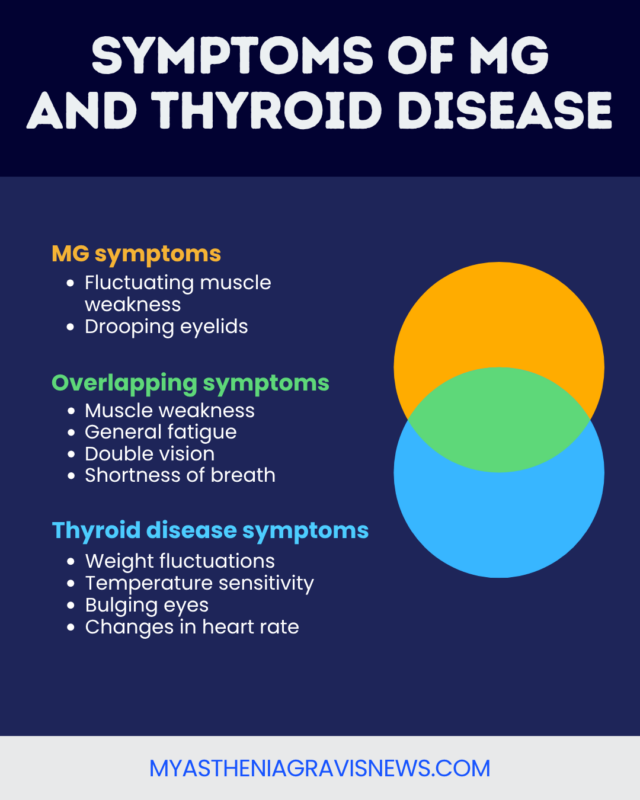
MG symptoms and thyroid problems can overlap, making it difficult to distinguish their causes. MG symptoms that can also be caused by thyroid disease include:
- fatigue
- muscle weakness
- breathing difficulties
- eye problems
Both hypothyroidism and hyperthyroidism may add to fatigue in MG. Both forms of thyroid disease can also cause muscle and movement problems. Hypothyroidism can cause muscle weakness that may add to existing limb weakness in MG. Hyperthyroidism can cause muscle weakness, as well as tremors and other unwanted movements.
Thyroid issues can also affect heart rate and contribute to shortness of breath, which could overlap with breathing problems related to MG respiratory muscle weakness.
Certain forms of both Graves’ disease and MG can cause primarily eye-related symptoms — referred to as Graves’ eye disease and ocular MG, respectively. Both conditions can cause difficulty moving the eyes and double vision. Eyelid drooping is more common in ocular MG.
Given this symptom overlap, some people — particularly those with Hashimoto’s thyroiditis and MG — may have generally more severe MG when the two conditions overlap. However, this is not always the case. Some people with MG who have thyroid problems report a milder disease course than those without thyroid disease.
Diagnosis
Doctors may recommend thyroid function tests in MG patients at the time of their diagnosis and during follow-up care.
Additional testing may also be warranted if MG symptoms repeatedly flare up without an obvious cause, or if a person shows signs of a thyroid problem that may not be explained by MG, such as unexplained weight changes, temperature sensitivity, or bulging eyes.
Tests used to diagnose thyroid disease include:
- thyroid hormone tests: measure levels of thyroid hormones in the blood to determine if the thyroid is over- or underactive
- thyroid antibody tests: identify the antibodies that target the thyroid in Graves’ disease or Hashimoto’s disease
- ultrasound imaging: visualize changes in the structure of the thyroid
- radioactive iodine uptake test: uses a swallowed radioactive tracer and a specialized device to measure the activity of the thyroid gland
Hormone and antibody tests are blood tests that may be part of routine monitoring in MG, while imaging or iodine tests may be warranted if a thyroid issue is suspected.
Clear communication about symptoms can help patients and their healthcare providers diagnose coexisting thyroid problems in MG.
Treatment considerations when you have both conditions
Although there are commonalities between the overlapping autoimmune conditions, MG and thyroid disease are treated differently.
Typically, MG treatment focuses on improving nerve-muscle communication or suppressing the abnormal immune activity that’s causing problems. Thyroid treatments often aim to correct hormone imbalances rather than directly affecting immune activity.
Treatment for Graves’ disease may include:
- radioactive iodine therapy: shrinks the thyroid and decreases its activity
- antithyroid medication: reduces thyroid hormone production
- beta blockers: block the effects of excess thyroid hormone to ease symptoms
- thyroidectomy: surgical removal of the thyroid
Graves’ eye disease can also be treated with corticosteroids, a type of powerful anti-inflammatory medication that may be used in MG.
The most common Hashimoto’s disease treatment is hormone replacement therapy, which provides the body with synthetic versions of thyroid hormones.
In general, thyroid treatments can be used alongside MG treatments. However, some people with hyperthyroidism and MG may experience worsening MG muscle weakness with certain medications, including beta blockers and some antithyroid medications.
Close monitoring and communication between people living with MG and their doctors — including their neurologist and endocrinologist — is important throughout treatment.
When to talk to your doctor
People with MG may want to ask their doctors about an evaluation for thyroid disease if:
- MG symptoms, particularly symptoms that overlap with thyroid disease, persist or worsen despite treatment
- additional symptoms consistent with thyroid disease emerge
- they have a history of thyroid problems
Individuals with both MG and a known thyroid condition should stay in close contact with their healthcare providers, particularly if they notice that thyroid treatment affects their MG symptoms.
Myasthenia Gravis News is strictly a news and information website about the disease. It does not provide medical advice, diagnosis, or treatment. This content is not intended to be a substitute for professional medical advice, diagnosis, or treatment. Always seek the advice of your physician or other qualified health provider with any questions you may have regarding a medical condition. Never disregard professional medical advice or delay in seeking it because of something you have read on this website.