
FDA approves 4-times-a-year injection therapy for generalized MG
Cemdisiran, to be marketed as Livsayis, may reduce treatment burden
Written by |
FDA approval of a quarterly gMG injection treatment brings patients a new option. (Image by iStock)
The U.S. Food and Drug Administration (FDA) has approved the injection therapy cemdisiran for adults with generalized myasthenia gravis (gMG) who test positive for the most common type of self-reactive antibodies driving the disease.
With this approval, the Regeneron Pharmaceuticals therapy — to be marketed under the brand name Livsayis — becomes the first small interfering RNA (siRNA)-based treatment approved in the U.S. for gMG. It is also the only gMG treatment that can be administered as a subcutaneous (under-the-skin) injection just four times a year.
Six-month data from a global Phase 3 clinical trial, NIMBLE (NCT05070858), showed that Livsayis significantly eased symptoms and reduced their impact on daily activities for people with gMG.
“In the Phase 3 NIMBLE trial, Livsayis delivered rapid, deep disease control – maintained through the end of dosing intervals – and offers a four-times-a-year subcutaneous dosing schedule,” Tuan Vu, MD, a neurology professor at the University of South Florida Morsani College of Medicine and a global principal investigator on NIMBLE, said in a press release from Regeneron. “These results highlight how a first-of-its-kind approach can address a key driver of disease and provide a compelling treatment option.”
A decision on a similar application in the European Union is expected in the second half of 2027. Regeneron plans to file for approval in other regions, including Japan.

Fewer doses may ease treatment burden
“Individuals living with gMG experience profound muscle weakness that can affect how they talk, see, breathe and move, and with it their ability to carry out everyday activities,” said Samantha Masterson, president and CEO of the Myasthenia Gravis Foundation of America (MGFA). “With Livsayis, those living with generalized myasthenia gravis have a new option that may help maintain disease control while reducing the burden treatment can place on daily life.”
Myasthenia gravis (MG) occurs when self-reactive antibodies mistakenly attack proteins involved in proper communication between nerves and muscles, causing MG symptoms such as muscle weakness and fatigue. In gMG, weakness and fatigue can affect multiple parts of the body rather than being limited to a particular group of muscles.
The most common self-reactive antibodies driving the disease target the acetylcholine receptor (AChR) protein. This antibody-target binding can activate a part of the immune system, called complement system, that further contributes to tissue damage.
Livsayis uses siRNA, a short piece of genetic material, to suppress the production of C5, a protein of the complement system. By reducing C5 levels, the therapy is expected to limit overactivation of the complement system and ease symptoms.
Four other C5-targeting treatments are approved for AChR-related gMG in the U.S. Soliris (eculizumab) and Ultomiris (ravulizumab-cwvz) are administered via into-the-vein infusions by a trained healthcare professional every other week or every two months, respectively.
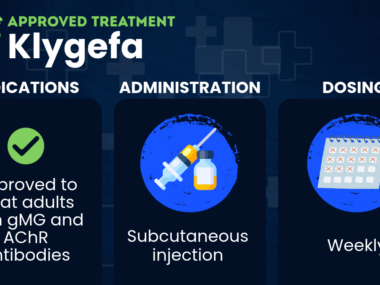
Zilbrysq (zilucoplan) and Klygefa (gefurulimab) are given by subcutaneous injection, once daily and once a week, respectively, and can be self-administered by patients at home.
While Livsayis needs to be administered by a healthcare provider, its quarterly dosing schedule potentially reduces the treatment burden for patients.
The approval of Livsayis draws on positive data from NIMBLE, which tested the therapy alone or in combination with pozelimab, an antibody designed to block C5, in 288 adults diagnosed with gMG.
Participants were randomly assigned to receive either Livsayis once every three months, Livsayis in combination with pozelimab once a month, or a placebo once a month for about six months.
After six months of treatment, participants who received Livsayis alone experienced a mean 4.5-point score reduction in the MG-Activities of Daily Living (MG-ADL) scale and a 4.2-point score drop in the Quantitative MG score (QMG) scale.
Score changes in these standard gMG measures reflected reductions in the disease’s impact on daily activities and in muscle weakness that were greater than those observed with the combination of Livsayis plus pozelimab or the placebo.
Patients treated with Livsayis alone were also significantly more likely than those on the placebo to experience clinically meaningful score reductions in both the MG-ADL scale (76.6% vs. 44.1%) and the QMG scale (48.4% vs. 19%). Clinically meaningful MG-ADL score reductions were observed as early as two weeks, with no signs of waning effect before the next dose.
Livsayis was generally safe and well tolerated. The most commonly reported adverse events with the therapy in trials were injection site reactions, viral infections, and urinary tract infections.
Like other C5-targeting treatments, the therapy’s U.S. prescribing information includes a boxed warning noting that the medication may increase risk of certain serious infections. The therapy will only be available in the U.S. through a restricted risk evaluation and mitigation strategy program.
The Muscular Dystrophy Association (MDA) cheered the approval.
“Over the past decade, we have witnessed a remarkable transformation in the treatment landscape for people living with myasthenia gravis,” Angela Lek, PhD, MDA’s chief research officer, said in an association press release. “The approval of new targeted therapies has expanded options for the myasthenia gravis (MG) community and reflects the progress that is possible when scientific discovery, clinical research, and patient advocacy come together.”



Leave a comment
Fill in the required fields to post. Your email address will not be published.