
Generalized myasthenia gravis treatment options
 Fact-checked by Melissa Wright, MD, MG specialist
Generalized myasthenia gravis (gMG) treatment is highly individualized. Healthcare providers consider several factors when building a treatment plan, such as antibody status, how fast symptoms are progressing, other health conditions, and how a treatment is given. While there isn’t a gMG cure, treatments can help manage symptoms by targeting the immune system or improving communication between the nerves and muscles.
Because gMG is a condition that can change over time, treatment plans may also change. Understanding the different myasthenia gravis (MG) treatment options can help patients know what’s available, what may be right for them, and why their healthcare provider may change the treatment plan.
What is the best treatment for gMG?
There isn’t a single best gMG treatment. The ideal treatment differs between individual patients, usually combines more than one approach, and is expected to be adjusted over time. That means the answer to what is the best treatment for MG is different for each person.
“It took three years of experimenting with various treatments before my MG was controlled. … My neurologist encouraged me and advised patience. She said it can take years to bring MG under control.”
— Myasthenia Gravis News columnist Mark Harrington, “Tenacity keeps me going amid the symptoms of myasthenia gravis”
Drug treatments for MG act at different points in the disease process, so combining them can address multiple aspects of the condition in a way that a single medication may not.
A key distinction to understand is that gMG treatments may focus on providing either symptom relief or disease control. A person’s antibody status is one factor that can help a healthcare provider determine which treatments may work best.
gMG medications
MG medications do one of two jobs: easing the signaling problem so muscles work better now, or acting on the immune system so less damage is done over time. Most care plans use both.
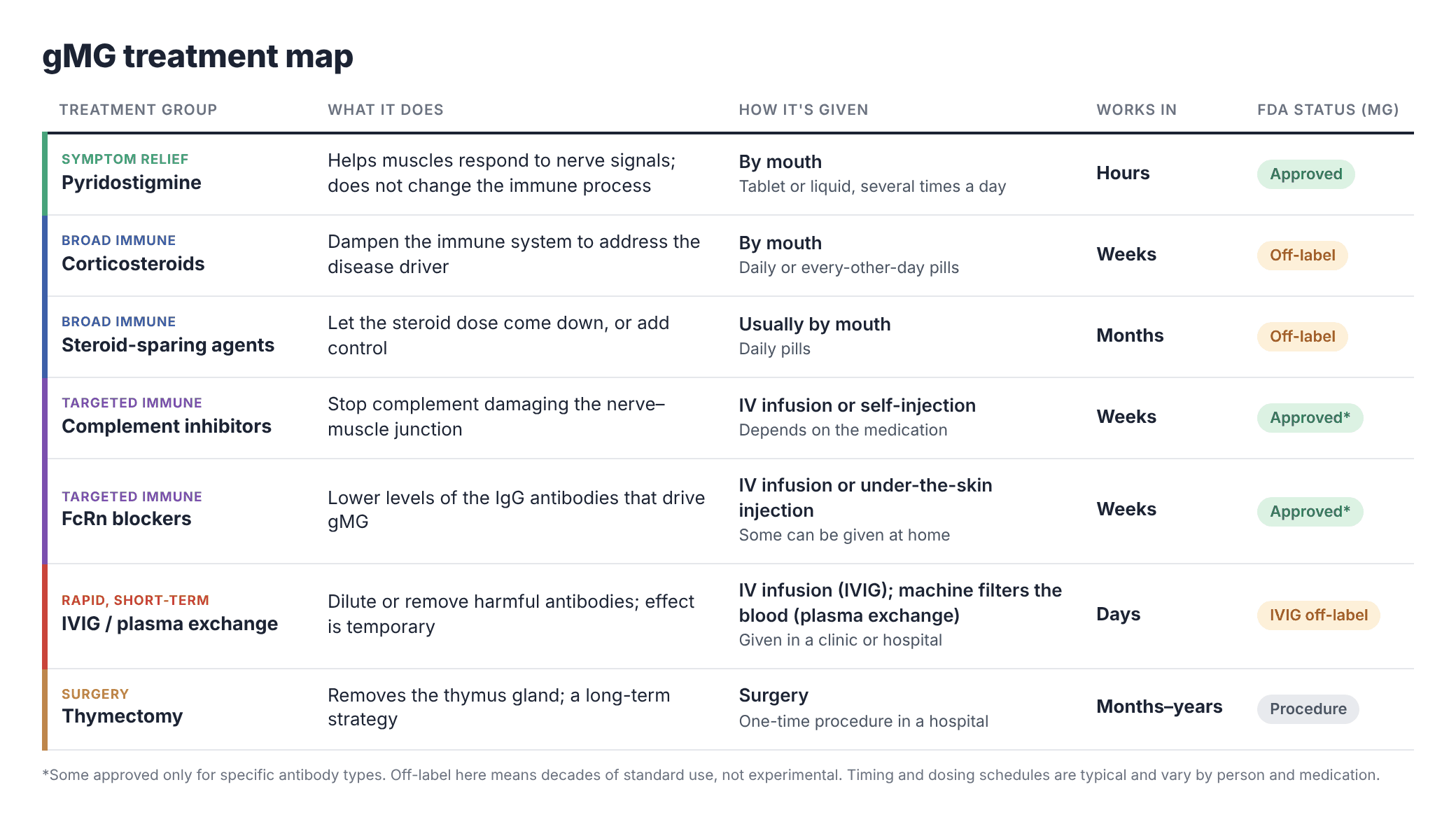
The map below shows how each type of gMG treatment works, how it’s given, how quickly it acts, and whether it’s FDA-approved for MG. The sections that follow cover each one in more detail.
Pyridostigmine for symptom relief
Pyridostigmine for MG helps muscles respond better to the nerve signals that are still getting through. It can ease symptoms within hours, but it does not slow or change the underlying autoimmune process.
Pyridostigmine is FDA-approved specifically for MG and is often the first treatment prescribed. Feeling better on pyridostigmine is not the same as gMG being controlled, and mistaking one for the other can keep people on an unchanged plan for years.
Steroids and other immunosuppressants
Corticosteroids and other immunosuppressants for MG act on the immune system rather than on the muscle, so they take longer to work — generally weeks for corticosteroids and months for the others — but they address what is driving the disease.
Although corticosteroids are a standard treatment for gMG, they are not FDA-approved specifically for this condition — meaning their use in gMG is considered off-label. Off-label here does not mean experimental. Corticosteroids have been used in gMG for decades, and international consensus guidance recommends them to address the underlying immune system process.
Steroid-sparing agents, oral immunosuppressants that allow the steroid dose to be lowered, are usually added if steroid side effects become a problem, the response is insufficient, or the steroid dose can’t be reduced without gMG symptoms returning. They are also used off-label.
Targeted treatments
Targeted therapies for gMG target specific parts of the immune process rather than suppressing it broadly.
Two classes of targeted therapies are used to treat gMG: complement inhibitors and FcRn blockers. Complement inhibitors stop part of the immune system, called complement, from damaging the junction where nerve meets muscle. FcRn blockers help the body clear IgG antibodies faster, lowering levels of the antibodies that drive gMG.
Unlike corticosteroids and steroid-sparing agents, medications in both classes are FDA-approved specifically for gMG. They can also work more quickly than older immunosuppressants — usually within weeks rather than months. However, several targeted treatments are approved only for people with particular antibodies, and approved uses vary by medication and can change over time. A specialist checks antibody results against each medication’s current label.
IVIG and plasma exchange
Intravenous immunoglobulin (IVIG) and plasma exchange work by removing or diluting the antibodies causing the problem, so they act quickly — usually within days — but the effect is temporary. They are mainly used to get someone through a flare or crisis, to prepare for surgery, or to hold the line while a slower treatment takes hold.
IVIG is a treatment that delivers antibodies from healthy donors to the bloodstream to help manage gMG symptoms. Plasma exchange removes the liquid part of the blood (plasma) that carries the harmful antibodies and replaces it with a substitute fluid, usually an albumin solution or donor plasma.
IVIG and plasma exchange can seem like a sign that gMG has become severe, but that isn’t always the case. Many people have a course before a thymectomy or during a rough patch, then return to their usual treatment plan. Some people with hard-to-treat gMG receive them on an ongoing schedule.
Thymectomy
Thymectomy is surgery to remove the thymus gland. Unlike medication, its benefit builds slowly, over months to years, so it is a decision made for the long run rather than for immediate relief.
Deciding whether to undergo a thymectomy for MG is a long-term decision, and whether it worked usually can’t be judged at the three-month mark. In the 2016 MGTX study, adults ages 18 to 65 with AChR antibody-positive gMG and no thymoma who had a thymectomy plus prednisone had better disease control and needed lower prednisone doses over 3 years than those who took prednisone alone.
Thymectomy is also generally recommended for anyone with a thymoma, a tumor of the thymus gland.
Choosing the right gMG treatment plan
A gMG plan is chosen based on a person’s situation and is expected to change. Common reasons to revisit it include symptoms that aren’t well enough controlled, side effects that outweigh the benefit, a hospitalization, a change in other health conditions, or a plan that simply hasn’t been reviewed in a long time.
Although it may seem like gMG is under control if symptoms aren’t getting worse, stable symptoms don’t necessarily mean a treatment plan is working well enough. For example, a person may stop cooking dinner because their arms get too tired or they avoid driving at night because of changes in vision.
These adjustments may have become part of the daily routine, but they are important signs of how gMG is affecting life. Sharing concrete examples like these with a healthcare provider may encourage them to revisit the treatment plan. People with gMG should avoid stopping or changing medications on their own, though, since stopping some gMG treatments suddenly can make symptoms worse.
“Self-sabotage is a hindrance. We spend so long downplaying how disabling this disease is, that sometimes we lose sight of how bad symptoms and side effects are affecting life.”
— Myasthenia Gravis New columnist Shawna Barnes, who has MG
Here is a sample script people with gMG may consider using:
“My plan hasn’t changed in a while, and I’d like to review it. Here’s what I’m still working around day to day: [two or three specific things]. Is this as controlled as we’d expect it to be, and what would make you consider a change?”
Before making changes to your current treatment plan, consider asking your healthcare provider these questions:
- What is this aiming for?
- How will we know it’s working?
- How long should I give it to work?
- What is the next option?
- Where is it given?
- How long will appointments take?
- Can I still work while having this treatment?
Myasthenia Gravis News is strictly a news and information website about the disease. It does not provide medical advice, diagnosis, or treatment. This content is not intended to be a substitute for professional medical advice, diagnosis, or treatment. Always seek the advice of your physician or other qualified health provider with any questions you may have regarding a medical condition. Never disregard professional medical advice or delay in seeking it because of something you have read on this website.