
Early use of off-label drug eases symptoms in gMG, study shows
Treatment with rituximab also reduced corticosteroid use in adults
Written by |

Treatment with rituximab within two years of diagnosis eases symptoms and reduces corticosteroid use in adults with generalized myasthenia gravis who test positive for antibodies against the AChR protein, a real-world study shows. (Photo from iStock)
- Early treatment with rituximab eases symptoms in adults with gMG who test positive for antibodies against the AChR protein.
- It also significantly reduces necessary corticosteroid doses, according to a real-world study.
- Similar results were observed among patients with very late-disease onset and those with hard-to-treat disease.
Treatment with rituximab within two years of diagnosis eases symptoms and reduces corticosteroid use in adults with generalized myasthenia gravis (gMG) who test positive for antibodies against the acetylcholine receptor (AChR) protein, a real-world study shows.
Two-thirds of patients achieved pharmacological remission, meaning no symptoms for one year and no signs of weakness on muscle examination while on some form of treatment. The remaining third showed minimal manifestations, indicating absence of symptoms that limit function but some evidence of weakness on muscle examination.
Similar results were observed among patients with very late-disease onset (65 years and older) and those with hard-to-treat disease.
“Our study highlights [rituximab’s] dual role both as a [corticosteroid-sparing] maintenance therapy and as an early immunosuppressive option for [corticosteroid] partial responders in addition to [hard-to-treat] AChR-positive gMG patients,” researchers wrote.
While corticosteroids, a type of anti-inflammatory and immunosuppressive treatment, are commonly used for gMG, their long-term and high-dose uses can lead to serious side effects.
The study, “Rituximab treatment in AChR-positive generalized myasthenia gravis within two years of diagnosis,” was published in Clinical Neurology and Neurosurgery.

Rituximab sometime used off-label in gMG to ease diseases severity
gMG is a rare autoimmune disorder marked by problems in the transmission of signals between nerves and muscles, leading to fluctuating muscle weakness. Most cases are caused by self-reactive antibodies that target the AChR protein.
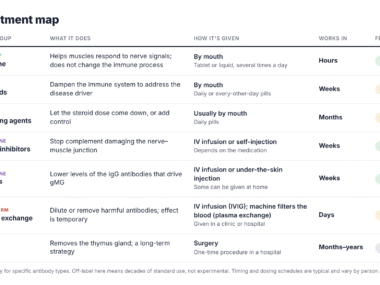
Rituximab, sold as Rituxan in the U.S. and MabThera in Europe, with biosimilars available, is a therapy targeting B-cells, the immune cells that produce antibodies, including those that drive gMG. While not specifically approved for gMG, it’s sometimes used off-label to ease disease severity.
In the Phase 3 Rinomax clinical trial (NCT02950155), rituximab increased the likelihood of achieving minimal disease manifestations and reduced the need for rescue therapy compared with a placebo. The trial excluded patients with a tumor of the thymus gland (thymoma), which is associated with MG, and those treated beyond one year from symptom onset.

Measure of disease impact improved significantly
In this study, scientists in Greece and Cyprus evaluated the outcomes of 24 adults, ages 22-85, with AChR-related gMG who received rituximab treatment within the first two years after diagnosis. Ten patients (41.7%) had very-late onset gMG and four (16.7%) had thymoma-associated gMG.
Before rituximab, all were receiving corticosteroids, and more than half (58.3%) had received intravenous immunoglobulin or plasma exchange, treatments that quickly reduce self-reactive antibody levels in the bloodstream.
Rituximab treatment was administered either as a single 500 mg infusion, two 500 mg infusions 15 days apart, or four weekly 500 mg infusions. Follow-up averaged 15.5 months, or little over one year.
Participants’ mean Myasthenia Gravis Activities of Daily Living (MG-ADL) scores, which assess the disease’s impact on daily activities, improved significantly from 1.9 before rituximab (baseline) to 0.32 at six months and zero (no impact) at 12 months.
Mean Quantitative Myasthenia Gravis (QMG) scores, a clinician-rated measure of muscle weakness, also improved significantly from 3.35 at baseline to 1.53 at six months and 2.0 at 12 months.
The mean daily dose of prednisolone, a corticosteroid, decreased from 22.4 mg at baseline to 11.4 mg at six months and 7.7 mg at 12 months.
61% achieved or maintained pharmacological remission at 6 months
At six months, more than half (61%) of participants achieved or maintained pharmacological remission, while about one-third (30%) had minimal manifestations. Similar results were observed at 12 months.
In the 16 (67%) people treated with rituximab to reduce corticosteroid exposure, all maintained pharmacological remission or minimal manifestations throughout follow-up. Among the five people (21%) on rituximab due to corticosteroid partial response or intolerance, one achieved pharmacological remission, three had minimal manifestations, and one showed improvement.
Three participants (12%) had an inadequate response to corticosteroids and to intravenous immunoglobulin or plasma exchange, and were severely affected by gMG. With rituximab, the mean MG-ADL score improved from 6.0 at baseline to 0.7 at six months and zero at 12 months. At six months, two were in pharmacological remission, and one had minimal manifestations.
The mean prednisolone dose fell in all of these three subgroups.
Treatment with rituximab as the only [non-corticosteroid] immunosuppressant within two years of diagnosis of AChR-positive generalized myasthenia gravis was associated with effective [corticosteroid-sparing] disease control.
Patients with very-late-onset disease showed comparable improvements in MG-ADL, QMG, corticosteroid reduction, and remission outcomes at six and 12 months, with no relapses reported. Among patients with thymoma, all but one achieved pharmacological remission at six months, while the other showed improvement.
When researchers divided patients by baseline disease severity, improvements in MG-ADL, corticosteroid reduction, and remission outcomes at six and 12 months were comparable between groups.
In terms of safety, a few patients experienced mild infusion reactions. No serious infections, clinically significant low antibody levels, late-onset low counts of a type of immune cell, or treatment-related adverse events requiring rituximab discontinuation were recorded.
“Treatment with rituximab as the only [non-corticosteroid] immunosuppressant within two years of diagnosis of AChR-positive generalized myasthenia gravis was associated with effective [corticosteroid-sparing] disease control,” the researchers concluded, noting favorable outcomes also observed in very-late-onset and thymoma-associated disease.



Leave a comment
Fill in the required fields to post. Your email address will not be published.