
Living well with MG means planning, self-awareness, asking for help
Webinar panelists shared tips for navigating driving, work, flares
Written by |
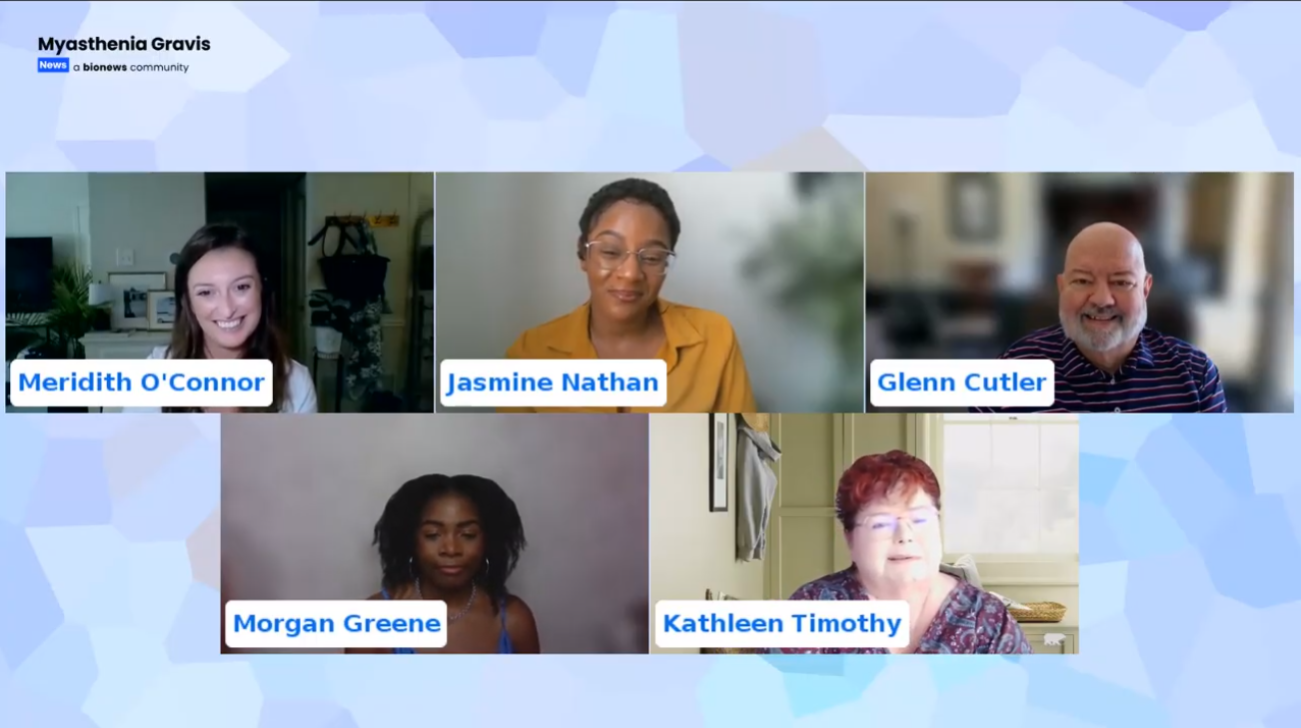
Panelists Meridith O’Connor, Jasmine Nathan, Glenn Cutler, Morgan Greene, and Kathleen Timothy discussed daily life with myasthenia gravis during a June 30 webinar hosted by Myasthenia Gravis News.
- Myasthenia gravis can cause muscle weakness, fatigue, and vision problems that affect daily activities like driving.
- Managing myasthenia gravis takes self-awareness, proactive planning, and knowing when to ask others for help.
- Tracking symptoms may help people spot flare warning signs and seek care quickly for possible crisis symptoms.
To successfully navigate life with myasthenia gravis (MG), people need to be aware of their own bodies and limitations, make proactive plans to set themselves up for success — and, above all, ask for help when it’s needed.
“Living with myasthenia gravis independently doesn’t necessarily mean we’re doing everything on our own … [it’s] about being in tune with your body, being intentional, having a plan, and … letting the people around you in,” Meridith O’Connor, a licensed master social worker who lives with MG, said during a webinar presented June 30 by Myasthenia Gravis News and its publisher, Bionews.

Panelists share daily-life strategies
The webinar, “Navigating the MG Day,” was sponsored by Argenx, the company that makes the approved generalized MG therapies Vyvgart (efgartigimod alfa-fcab) and Vyvgart Hytrulo (efgartigimod alfa and hyaluronidase-qvfc).
The event was moderated by O’Connor, who was joined by four other people living with MG to discuss what everyday life with the condition looks like: Glenn Cutler, Jasmine Nathan, Morgan Greene, and Kathleen Timothy.
MG is an autoimmune disease caused by self-reactive antibodies that ultimately impair nerve-muscle communication, leading to symptoms such as muscle weakness and fatigue. In many cases, the first manifestations of MG affect muscles around the eyes, leading to problems such as double vision or droopy eyelids.
Vision problems in MG can make driving difficult. Greene, who was diagnosed with MG 10 years ago, recounted a “whirlwind of worst-case scenarios” when she was driving to a CT scan during her diagnostic process.
She was experiencing severe double vision while driving in a thunderstorm, and ultimately, she ended up using a paper towel wrapped around a pair of sunglasses to create a makeshift eye patch.
“It’s very scary, of course, when those things are happening to you,” Greene said.
Timothy, who was formally diagnosed with MG in 2018, said that because she experiences “almost constant” blurry vision, she “decided it just was not safe for me to drive.” Still, she said that losing the sense of independence was one of the hardest aspects of her journey with the disease.
For patients who still drive, the panelists stressed the importance of implementing strategies to help make it safer. For instance, Nathan, a U.S. Department of Veterans Affairs program specialist who also was diagnosed in 2018, said she tried to drive in the morning when she had more energy, avoiding late-night drives when she was more likely to be fatigued.
Self-awareness guides daily choices
Checking for symptoms on any given day is also key. In some cases, it can be helpful to do a quick test of eye tracking ability, such as by moving a finger back and forth in front of the face and following those movements. The panelists also highlighted the importance of having a backup plan for transport if driving ends up being unsafe.
“You’ve just got to be aware,” Cutler said. “Self-awareness is such an issue with [MG] anyway. You have to know your own limits, and … before you get out and decide to do something, you gotta see: am I clear? Am I clear-headed? It’s more than just the vision itself.”
Self-awareness is also key for navigating work and employment with MG. In many cases, patients end up changing how they work — whether by seeking reasonable accommodations, making adjustments such as working remotely, or even pursuing new career paths.
“I think it’s important to find a job that meets you where you are, and being flexible,” Greene said. “If you’re someone who really, really loves your job, but it’s so stressful and so demanding, and you’re not feeling like you’re meeting standards because of your health, it may be time to do a shift into something else.”
She noted that the fact that many people rely on their employers for health insurance coverage can make these transitions especially complex for individuals with chronic health conditions like MG.
Communication can support work
The panelists emphasized that, for those who choose to share their diagnosis, communicating with supervisors and coworkers can help make working with MG manageable, so that others at work can be understanding and make accommodations where needed.
“If [people with MG] are not willing to share, then they cannot expect to be accommodated, and accommodation is critical for us,” Cutler said. He recalled that he’d gotten a promotion at work shortly before being diagnosed with MG in the early 2000s, and he told his supervisor he would need changes such as a later start at work to give his medication time to kick in each morning.
Asking for help at work isn’t always simple or easy. That’s true even for Timothy, who works for the Myasthenia Gravis Foundation of America (MGFA). Although her coworkers are intimately familiar with the disease and its impact, Timothy said it can still be hard for her to admit when she needs help or an accommodation.
“Of course, [the MGFA is] very accommodating, allowing for rest periods and what I need,” Timothy said. “The issue with working, for me (and I work remotely), is that I don’t want to ask for help. It’s like I don’t want to be perceived as ill in the workplace, [even though] everyone knows I’m ill.”
Even though it’s often difficult, Timothy stressed the importance of asking for help when necessary. “In any workplace, before any accommodation can be made for you, you have to ask for the help,” she said.
Nathan agreed. She shared a recent experience with a myasthenic crisis, which can happen when an MG flare-up becomes severe and muscle weakness affects breathing, and said she was able to get help from coworkers. “I’m truly grateful to my coworkers and to my supervisor because just by me telling them about [MG], they were able to assist me with my crisis,” she said.
Tracking flares can guide care
A myasthenic crisis is a severe form of an MG relapse. Because relapses and crises can have such a profound impact, the panelists encouraged people with MG to be proactive about tracking their symptoms for warning signs of these flares.
Practical tips include keeping a daily log using a written diary or voice memos. It may be helpful to record symptoms at a set time each day, such as when brushing one’s teeth.
The panelists noted that warning signs of relapses can vary from person to person — Nathan said her flares are usually preceded by sudden worsening of vision, while Timothy said her biggest red flag for flares is difficulty holding her head up and weakness in her mouth and throat. The fact that the disease impacts each person differently and can change over time makes it especially important for each person to track their own experiences.
Several of the panelists recounted times early in their MG journey when they started experiencing signs of an impending flare, but they tried to ignore these symptoms and go about their days as normal. They emphasized that people should not try to push through worsening symptoms, and should seek help sooner rather than later.
“You’re not gonna push through [an MG flare]. You’re gonna have to stop and recognize what’s happening and accommodate that in whatever way works for you, whether that’s stopping and resting or some new medication,” Cutler said. “And you can’t be afraid to reach out and say, ‘This is what’s going on with me. I’m not sure I fully understand it either, but I need some help getting through.’”
Know when to seek help
The panelists noted that people with MG experiencing certain symptoms indicative of a crisis — such as coughing on thin liquids, struggling to breathe, or being unable to lift one’s head — should seek immediate medical attention.
Overall, the webinar highlighted how living with MG requires patients to be honest with themselves, and to reach out for help when they need it. O’Connor stressed that MG-related life changes should not be viewed in any way as failure, but rather as adaptation to evolving circumstances.
“It takes a mental shift to realize that this really isn’t about managing your attitude … it’s more about managing your nervous system … [and] what your body can handle,” O’Connor said.



Carl sanders
Loss of vision and muscle cramps l lose felling in my arms legs
Jodi Enders
Hi, thank you for reaching out and sharing this. Those symptoms sound really tough to deal with, and I want you to know you don't have to sort through them alone. While muscle weakness is very much part of MG, losing feeling in your arms and legs aren't typical characteristic MG symptoms, so they're absolutely worth getting checked promptly. Please reach out to your neurologist or care team as soon as possible to describe exactly what you're experiencing, and don't hesitate to seek emergency care. The good news is that getting the full picture is how you and your doctors get you the right answers and the right relief, and the sooner they hear about these changes, the sooner they can help. You're doing the right thing by paying attention to your body. Wishing you steady answers and better days ahead. — Jodi, Patient Advocate