
Guest Voice: My MG diagnosis led me to become a patient researcher
My observations turned into curiosity, and then into a real scientific question
Written by |

A diagnosis can change your life, but it doesn’t have to define it.
For me, living with myasthenia gravis (MG) doesn’t just mean learning how to manage the disease. It has helped me ask questions, notice patterns, and even become something I didn’t expect: a patient researcher.

Where it began
I was in respiratory failure, but I didn’t look like the kind of MG patient most doctors learn about in textbooks. I wasn’t gasping for air, I didn’t have retractions, and my oxygen was normal. I simply looked tired. And looking back, that’s where my journey with research began.
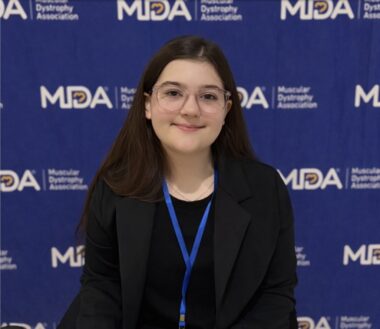
Elizabeth Madole, 12, attends a Muscular Dystrophy Association symposium in Dallas, in November 2025. (Courtesy of Elizabeth Madole)
Let me take you back to the beginning. The time between my first MG symptom at age 7 and my diagnosis was only a few weeks. At first, my parents thought I just needed to be more active, but the more I did, the weaker I got. Sometimes I couldn’t even get up off the floor afterward. What confused everyone was that after I rested, I got better.
I remember thinking everything was just getting so hard. I started coughing while drinking water, and by dinnertime, I could hardly eat. When I was admitted to the hospital, doctors were confused and kept saying my weakness didn’t make any sense. I remember a doctor saying, “Her exam is stronger in the morning and weaker by the end of the day. That doesn’t happen in neurology.” I didn’t know what that meant. All I knew was that the more I did, the harder everything got.
Then, my neuromuscular doctor met me for the first time, and he basically knew from my exam what was going on. A repetitive nerve stimulation test confirmed MG, and soon after, I was diagnosed with acetylcholine receptor antibody-positive MG.
I started treatment and got a lot better. But like so many people living with a rare disease, things didn’t remain stable. Right before my 10th birthday, I had my first myasthenic crisis and ended up in the pediatric intensive care unit for a month.
Repeated admissions inevitably made me realize the variability in how respiratory failure in neuromuscular disease is understood because oxygen can look normal even when something is life-threatening. I remember a doctor saying they rely on oxygen saturations because 99% of the time, they see hypoxemia when someone’s in respiratory failure.
I kept hearing, “Your oxygen’s fine.” But I wasn’t fine. I didn’t feel fine. I couldn’t lift up my head or say more than a couple words in a sentence, and I didn’t even have the muscle strength to show retractions. I looked fine until a blood gas test showed worsening respiratory failure and carbon dioxide retention, and everyone realized it was an emergency.
Turning experience into research
Most tests used to monitor MG are effort-dependent (or subjective), such as negative inspiratory force and forced vital capacity. So, in a disease that doesn’t always show typical signs of respiratory distress and subjective complaints, this can lead to disbelief and delays in treatment. That’s why I started thinking about whether there could be a more objective way to see what’s happening — one that doesn’t depend on a patient’s effort.
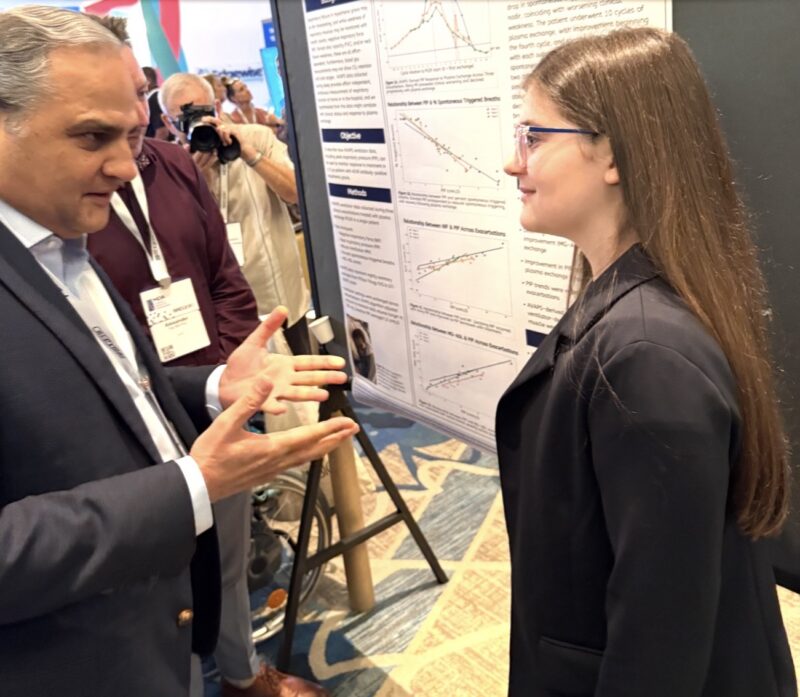
Elizabeth Madole presents her research on respiratory monitoring in MG and response to treatment as first author alongside her neurologist, Alex Fay, at the 2026 MDA Clinical and Scientific Conference in Orlando, Florida. (Courtesy of Elizabeth Madole)
I noticed patterns in my ventilator data while using a mode called average volume-assured pressure support, which adjusts pressure to maintain a set tidal volume. The pattern was simple: When I was doing well, the pressure I needed was low. As I got worse, the pressure increased.
When I would start plasmapheresis, those pressures would decrease in a consistent and predictable way every time. That is when I realized these data were objective. They didn’t depend on effort. And they seemed to show my disease progression in a way doctors couldn’t dismiss, unlike other tests used in MG.
That observation turned into curiosity, and then into a real scientific question. My neurologist saw the same pattern, and we decided to review all of the data, write an abstract, and present it at the 2026 MDA Clinical and Scientific Conference. We’re now working toward publication in the hope that this information can truly help other patients.
To submit your own Guest Voice for publication on Myasthenia Gravis News, please email your idea to our columns manager at [email protected] with the following included in the subject line: “Guest Voice: Myasthenia Gravis News.”
Note: Myasthenia Gravis News is strictly a news and information website about the disease. It does not provide medical advice, diagnosis, or treatment. This content is not intended to be a substitute for professional medical advice, diagnosis, or treatment. Always seek the advice of your physician or other qualified health provider with any questions you may have regarding a medical condition. Never disregard professional medical advice or delay in seeking it because of something you have read on this website. The opinions expressed in this column are not those of Myasthenia Gravis News or its parent company, Bionews, and are intended to spark discussion about issues pertaining to myasthenia gravis.


Sherrie Edwards
So proud of Elizabeth for sharing, learning and being an advocate for MG