
Interpreting pulmonary function tests for myasthenia gravis
 Fact-checked by
 Pulmonary function tests, or PFTs, are used to identify and monitor respiratory muscle weakness in myasthenia gravis (MG), an autoimmune neuromuscular disorder.
MG occurs when the immune system mistakenly targets proteins that help nerves and muscles communicate, leading to muscle weakness and fatigue. If the breathing muscles are affected, it can lead to episodes of life-threatening respiratory failure known as myasthenic crises and increase the risk of airway infections.
PFTs are lung function tests that track changes in respiratory muscle strength and breathing abilities over time. Interpreting MG pulmonary function tests within the context of other clinical signs and symptoms may help anticipate complications and adjust treatment as needed.
Common pulmonary function tests
Depending on symptoms and available diagnostic equipment, doctors may recommend a combination of several MG breathing tests to track different aspects of pulmonary function, including:
- spirometry to measure how much air can be inhaled and exhaled
- pressure tests to measure the force of inhaling and exhaling
- bedside and home monitoring to evaluate breathing at home or in resource-limited settings
Spirometry
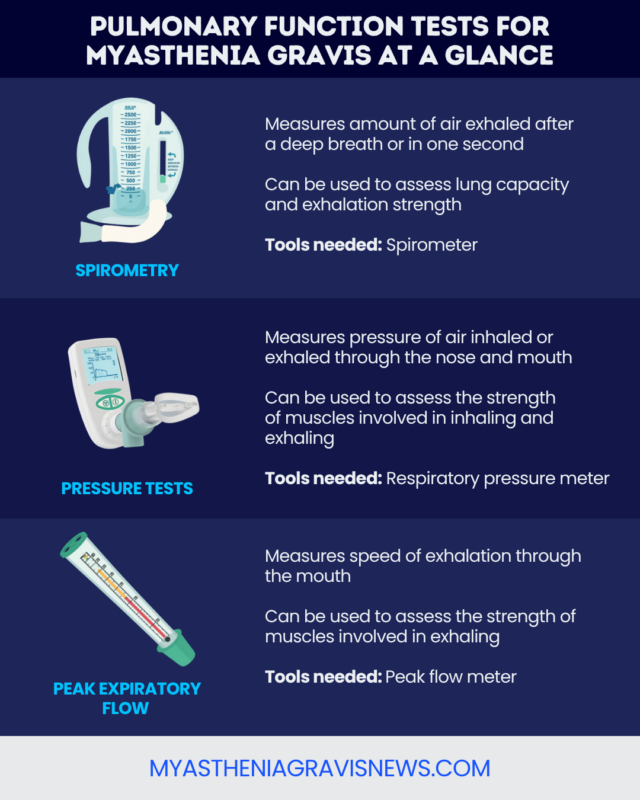
Spirometry in MG helps evaluate lung capacity and identify general signs of respiratory muscle weakness. A tube-like device (spirometer) is placed in the mouth, and individuals are asked to inhale and exhale while sitting or lying down. There are two main measurements assessed with a spirometer:
- Forced vital capacity (FVC): how much air can be forcibly exhaled after a deep breath, as hard and as fast as possible
- Forced expiratory volume (FEV): how much air can be exhaled in a set amount of time, often one second (FEV1)
FVC, which estimates the amount of air the lungs can hold, is the primary test used to monitor respiratory decline in MG. Slow vital capacity (SVC) is a gentler, less fatiguing evaluation that can offer similar information. It measures how much air is gently exhaled at a relaxed, slow pace after taking a breath.
FEV1 is usually measured alongside FVC, and the ratio of the two can help identify airway obstructions, although such obstruction is uncommon in MG.
Pressure tests
Pressure tests measure the force of the air that’s inhaled or exhaled, providing information about the strength of the breathing muscles. They include:
- maximal inspiratory (MIP) and expiratory pressure (MEP): the force of inhalation and exhalation through the mouth
- nasal inspiratory force (NIF): also called sniff nasal inspiratory pressure, the force of inhalation through the nose
Tracking changes in MIP, MEP, and NIF values in MG may support early recognition of respiratory muscle problems. During these tests, individuals inhale and exhale into a meter that measures air pressure.
A low MIP or NIF could mean it’s harder for a person to inhale air into the lungs, while a low MEP means it is more difficult to cough and clear airway secretions through exhalation.
Other tests
The peak expiratory flow (PEF) test uses a simple, inexpensive device called a peak flow meter to measure the speed of airflow during exhalation.
A single-breath counting test is a bedside screening tool that correlates with other PFTs and can be used in settings where spirometry is not available. It measures how high a person can count aloud in a single exhale.
These tests are easy, inexpensive screening tools that are especially useful in low-resource settings where spirometry and other tests are less accessible.
Understanding your test results
Understanding MG respiratory function test results involves placing the numbers in the context of a person’s breathing-related symptoms and evaluating how they change over time.
Normal values for pulmonary function tests are determined by factors such as age, sex, and height. Respiratory muscles naturally become weaker with age, so small, gradual declines are considered normal.
FVC, the most widely used PFT, is often reported as a percentage of what would be expected in a healthy person with similar characteristics. Specific FVC thresholds may vary, but a percent predicted FVC of less than 80% is often flagged as abnormal.
Each person’s doctor will explain their specific pulmonary function test results and what they might mean.
Certain PFT results may indicate an impending myasthenic crisis. These include:
- FVC less than 20 mL/kg
- NIF worse than -30 cm H2O
- MEP less than 40 cm H2O
If these myasthenic crisis respiratory parameters are met, doctors generally recommend initiating invasive respiratory support. However, these numbers are not hard-and-fast rules and are always interpreted within a broader clinical context, particularly because PFTs may be less reliable in people with significant weakness of the facial or neck muscles.
What your results might mean for your care
By tracking MG symptoms and lung function over time, patients and doctors can work together to adjust care as needed. Possible results and recommendations include:
- stable pulmonary function: continue current care and monitoring
- gradually declining pulmonary function: increasing monitoring or changing treatment approaches
- suddenly declining pulmonary function: close monitoring and interventions to prevent a myasthenic crisis
For some patients, doctors may recommend monitoring respiratory function in between clinic visits with home spirometry or PEF devices.
Warning signs that go beyond the numbers
PFT results are not the only indicator of a myasthenic crisis. People with MG should always monitor their symptoms and know when to seek help for breathing problems.
Signs of respiratory failure in MG can include:
- shortness of breath
- fast and shallow breathing
- the abdomen moving inward rather than outward while inhaling
- severe or rapidly worsening muscle weakness anywhere in the body
- difficulty swallowing
- slurred speech
- weak cough
Patients should always seek urgent medical care for any of these symptoms, regardless of their most recent lung function test results.
Myasthenia Gravis News is strictly a news and information website about the disease. It does not provide medical advice, diagnosis, or treatment. This content is not intended to be a substitute for professional medical advice, diagnosis, or treatment. Always seek the advice of your physician or other qualified health provider with any questions you may have regarding a medical condition. Never disregard professional medical advice or delay in seeking it because of something you have read on this website.