
Refractory myasthenia gravis: management and challenges
 Fact-checked by
 Refractory myasthenia gravis (MG) is a form of the neuromuscular condition that is difficult to control with standard treatments. About 10% to 20% of people with MG meet criteria for refractory MG, also called treatment-resistant MG.
In MG, the immune system mistakenly targets proteins that support communication between nerves and muscles. As this communication breaks down, muscle weakness, fatigue, and other symptoms develop.
Standard MG treatments aim to restore nerve-muscle communication or reduce the misdirected immune activity that drives the condition. When this doesn’t work, a case of MG may be considered refractory and require alternative treatments.
Why does myasthenia gravis become refractory?
Scientists don’t understand the exact causes of refractory MG, but several factors are associated with a higher risk of MG not responding to treatment, including:
- testing positive for disease-causing antibodies against muscle-specific kinase (MuSK)
- having a thymus gland tumor (thymoma)
- experiencing weakness in the face and neck (bulbar) muscles and respiratory muscles
- being younger and female
Many MG treatments were initially designed for people with antibodies against acetylcholine receptors, the most common cause of the disease. It is possible that anti-MuSK antibodies disrupt nerve-muscle communication in ways that available therapies don’t account for.
Thymoma and bulbar or respiratory involvement are associated with more severe disease, which could influence the treatment response.
Additionally, experiencing severe medication side effects or having coexisting medical conditions can limit treatment options, potentially leading to a refractory condition.
Signs your condition may be refractory
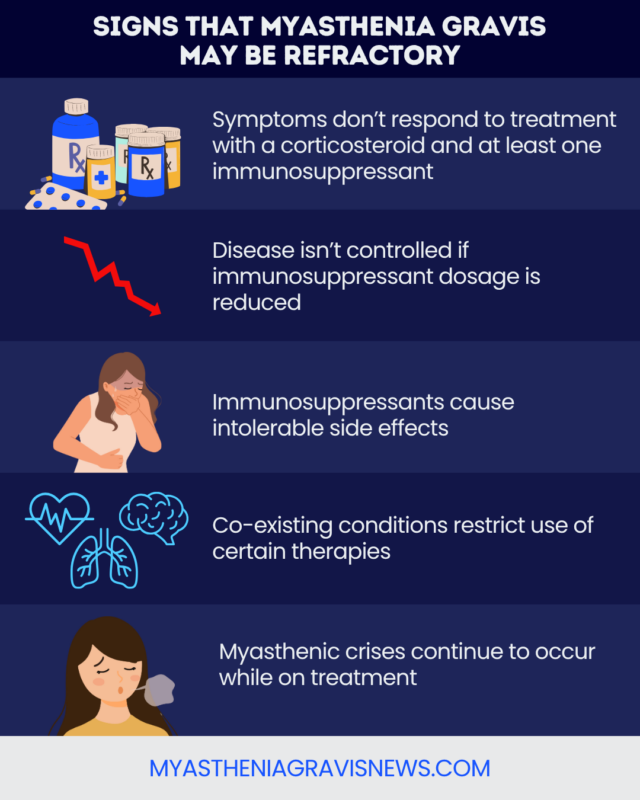
MG symptoms can fluctuate on a daily basis, but refractory MG symptoms reflect a persistent and long-term failure to respond to treatment. Some possible signs that MG has become refractory include:
- persistent symptoms: muscle weakness and fatigue are not well-controlled and continue to interfere with daily life after standard treatment, including corticosteroids and at least one other immunosuppressant
- inability to taper immunosuppressants: symptoms are controlled with high-dose immunosuppressants, but the medications can’t be tapered without symptoms immediately worsening, leading to a reliance on long-term immunosuppressants in MG that can cause undesirable side effects
- treatment limitations: severe side effects of MG treatments or other medical conditions restrict the use of conventional therapies and limit effective options
- recurrent myasthenic crises: repeated incidents of life-threatening breathing problems (myasthenic crises) or a regular dependence on rescue therapies
Patients should always report any changes in their symptoms to a care provider, who can assess whether their disease has become refractory.
Diagnosis
There is no universally recognized definition of refractory MG, so the diagnosis depends on a doctor’s clinical judgment. In general, if muscle weakness isn’t improving, MG fatigue persists despite ongoing treatment, or myasthenic crisis risk remains high, doctors may flag the disease as refractory.
Identifying refractory MG can take some time because symptoms need to be tracked over the long term. To make the diagnosis, a physician will carefully review a person’s symptom history and may run standard MG diagnostic tests to assess whether nerve, muscle, and lung function are also objectively worsening.
During this process, it is important to rule out other possible causes of worsening symptoms, including MG flare-ups, which are temporary periods of symptom worsening triggered by factors such as infections or stress. Medication noncompliance and other health issues must also be ruled out.
Treatment options
For people living with refractory MG, finding an effective treatment may be challenging. Each person’s immune system responds differently to treatments, so chronic MG management is always an individualized process.
Refractory MG treatment options depend on disease type, the presence of disease-causing antibodies, and other factors, but may include:
- approved MG therapies: medications that work in various ways to suppress MG-related immune activity, including complement inhibitors and FcRn blockers
- Rituximab: an antibody therapy not specifically approved for MG, but which may be used off-label in some situations
- rescue therapies: treatments to manage serious symptom worsening or to help provide clinical stability, including plasma exchange or intravenous immunoglobulin (IVIG)
- thymectomy: removal of the thymus gland, an immune organ in the chest that may be abnormal in MG
Approved MG medications
Newer classes of approved MG medications, including complement inhibitors and FcRn blockers, work in more specific ways than traditional immunosuppressants. These are recommended for refractory MG that hasn’t responded to standard immunosuppressants.
Other options
People with refractory MG might also respond to rituximab (sold as Rituxan and others), especially when they are positive for MuSK antibodies.
In certain situations, doctors may recommend escalating immunosuppressive treatment with agents such as cyclophosphamide, a chemotherapy agent. However, this approach is not included in modern guidelines because more effective and safer options are available.
Thymectomy is a first-line treatment for people with thymus gland abnormalities. It may also be considered for people without thymomas, especially if the response to immunosuppressants was poor.
Rescue therapies
Plasma exchange, a blood-filtering procedure that removes disease-causing antibodies, and IVIG, an infusion of antibodies from healthy donors, are used to manage severe MG complications, including myasthenic crises. They are not typically recommended as maintenance therapies.
Experimental treatments
Emerging experimental medications may also offer new treatment pathways for refractory MG. This includes CAR T-cell therapy, an experimental immunotherapy for MG that aims to reprogram the immune system in beneficial ways.
If such options are eventually approved, they may be a promising option for cases of MG that don’t respond to conventional therapy.
Myasthenia Gravis News is strictly a news and information website about the disease. It does not provide medical advice, diagnosis, or treatment. This content is not intended to be a substitute for professional medical advice, diagnosis, or treatment. Always seek the advice of your physician or other qualified health provider with any questions you may have regarding a medical condition. Never disregard professional medical advice or delay in seeking it because of something you have read on this website.