
Myasthenia gravis vs. ALS: What’s the difference?
 Fact-checked by
 Myasthenia gravis (MG) and amyotrophic lateral sclerosis (ALS) are both neuromuscular diseases that can affect the muscles needed for movement, breathing, speaking, chewing, and swallowing.
While they might look similar early on in their course, the two conditions have different underlying causes and treatment approaches. Disease progression and prognosis also differ; while ALS substantially impacts survival, most people with MG have a relatively normal life expectancy.
Understanding the difference between MG and ALS can help patients know what to expect with their specific diagnosis.
Key differences at a glance
While both MG and ALS are neuromuscular diseases that lead to muscle weakness, their underlying causes and progression patterns differ.
- MG: An autoimmune disease in which the immune system mistakenly attacks sites of nerve-muscle communication. It leads to fatigable muscle weakness, meaning weakness that worsens with activity and eases with rest.
- ALS: A neurodegenerative disease without a well-established cause in which the nerve cells that control movement (motor neurons) die off. It leads to progressive muscle weakness and wasting that worsens steadily over time.
MG and ALS symptoms can be similar, as both conditions can lead to movement problems, breathing issues, and difficulties swallowing and speaking.
Many people with MG start with weakness of the muscles that control the eyes and eyelids (ocular MG), leading to symptoms such as ptosis (drooping eyelids) or double vision. This may progress to more generalized weakness that affects walking, breathing, facial expressions, eating, and speaking. In general, MG symptoms are most severe in the first few years after disease onset but may stabilize or improve over the long term with appropriate treatment. It is rare for MG to lead to permanent and complete disability.
ALS can affect many of the same muscle groups as MG, although eye muscles are usually spared. Muscle weakness in ALS often starts in the limbs and progressively worsens to the point of paralysis. Within a few years, people with ALS typically lose their ability to walk, speak, eat, and breathe on their own.
Scroll horizontally to view all columns -->
| Disease features | MG | ALS |
|---|---|---|
| Causes | Autoimmune reactions | Unknown; combination of genetic and environmental risk factors |
| Symptoms | Fatigable muscle weakness; may be restricted to the eyes or generalized | Progressive, generalized muscle weakness |
| Progression and life expectancy | Ocular MG may progress to generalized MG; complete disability is very rare, and life expectancy is usually normal | Muscle weakness progresses to complete disability and death within about 2-5 years |
| Treatment | No cure; treatment aims to improve muscle function and quality of life | No cure; treatment aims to slow disease progression and manage symptoms |
| Who is most commonly affected? | Women younger than 40 and men older than 60 | People ages 55-75, occurring more often in men |
Causes and underlying mechanisms
Muscle weakness in MG and ALS has different underlying causes, which is why the two conditions are diagnosed and treated differently.
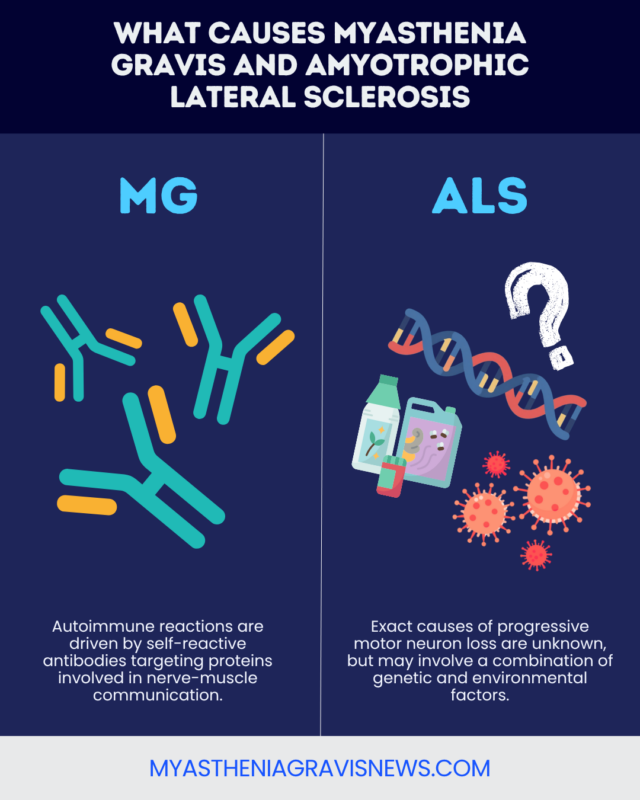
- MG: The immune system produces self-reactive antibodies that target proteins involved in nerve-muscle communication, impairing signaling that mediates muscle contractions. The cause of these abnormal immune reactions is unclear, but it may involve abnormalities in the thymus gland, an immune organ in the chest. Genetic factors may also influence disease risk.
- ALS: Motor neurons progressively and irreversibly die, leading to severe muscle weakness. The exact causes of ALS are not known, but the disease may arise through a combination of genetic and environmental risk factors, including smoking, toxic chemical exposure, viral infections, and others. ALS may sometimes run in families through inherited genetic mutations.
How diagnosis differs
Diagnosing MG or ALS always involves collecting a medical history and symptom review, along with a thorough physical and neurological exam. Thereafter, doctors may order several diagnostic tests:
- MG: A blood test to identify disease-causing antibodies can often confirm an MG diagnosis. Tests to assess nerve and muscle function, as well as imaging scans to visualize the thymus, may support a diagnosis.
- ALS: Tests to evaluate nerve and muscle function are also used to diagnose ALS, along with MRI imaging, muscle and nerve biopsies, and spinal fluid lab analyses. Genetic testing might also be used for an ALS diagnosis
Neither disease has a single diagnostic test. Both rely on a series of tests to rule out other conditions and identify characteristic disease patterns.
Treatment and management
Neither ALS nor MG has a cure, but each has available treatments.
- MG: Treatment focuses on improving muscle function and controlling the immune system. Available medications primarily work to suppress abnormal immune activity, reduce the levels of harmful antibodies, or boost nerve-muscle signaling. Surgery to remove the thymus gland (thymectomy) may also help in some cases.
- ALS: ALS management options aim to slow disease progression and manage symptoms. Disease-modifying therapies work in different ways to protect motor neurons against damage. Supportive care options, like physical therapy, speech therapy, and nutritional support, can help maximize comfort and quality of life.
In either disease, lifestyle changes, such as physical activity and a healthy diet, may help patients stay as healthy as possible for as long as possible. Mental healthcare and emotional support are also key.
Prognosis and life expectancy
The long-term outlooks for MG vs. ALS are substantially different:
- MG: MG is characterized by fluctuating muscle weakness, with periods when symptoms worsen (exacerbations) and periods when symptoms are minimal or absent (remission). With proper treatment, MG does not usually steadily worsen or affect life expectancy.
- ALS: ALS symptoms get continuously worse over time, eventually leading to paralysis, even with treatment. Most people with ALS will live 2 to 5 years after their symptoms start.
While the ALS prognosis is generally worse, living with MG or ALS can have a substantial impact on quality of life. Strong support systems and regular follow-up with a multidisciplinary care team will help ensure the best possible outcomes with either disease.
Myasthenia Gravis News is strictly a news and information website about the disease. It does not provide medical advice, diagnosis, or treatment. This content is not intended to be a substitute for professional medical advice, diagnosis, or treatment. Always seek the advice of your physician or other qualified health provider with any questions you may have regarding a medical condition. Never disregard professional medical advice or delay in seeking it because of something you have read on this website.