I’m just beginning the journey of living with myasthenia gravis
Written by |
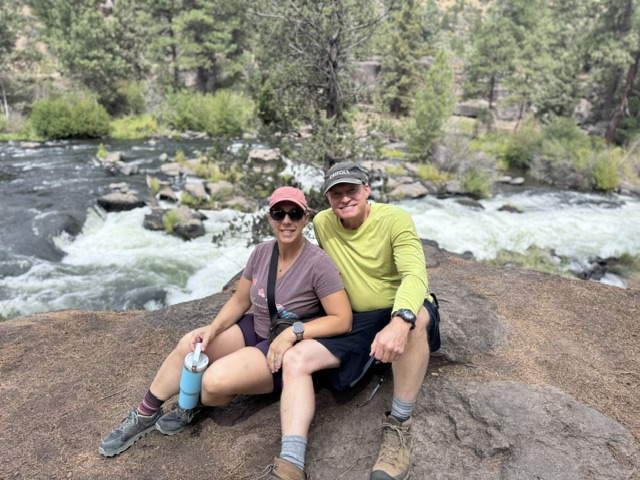
Jenn Rosso, left, on a trail run with her husband Robert Rosso. (Photos courtesy of Jenn Rosso)
In recognition of Myasthenia Gravis Awareness Month in June, the MG Awareness Month campaign features a series of stories highlighting the real-life experiences of people affected by MG, written in their own words. Follow us on Facebook, Instagram, or X for more stories like this, using the hashtag #MGAwarenessMonth, or read the full series.
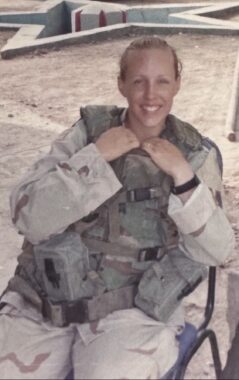
Rosso in Iraq in 2003, when she served in the U.S. Army.
My husband describes my myasthenia gravis (MG) diagnosis as akin to my being struck by lightning or hit by a car. One day, I was fine and normal; the next day, I wasn’t.
I am 51 and a registered nurse living in Southern California. I’ve been in this field for more than 20 years, and I love my career. After eight years in the U.S. Army as a military police officer and returning home from the Iraq war in 2003, I was ready to transition into nursing.
In 2019, I was admitted to the emergency department for high blood pressure. There was no sign of a heart attack, so the doctors decided to do a chest X-ray and an angiogram to see if there were any structural abnormalities in or around my heart.
When the ER physician came to give my husband and me the results, she closed the door and drew the curtain. We knew this couldn’t be good news. She told me I “lit up like a Christmas tree” under the X-ray. She said I had a huge tumor that was crushing my heart and causing my elevated blood pressure, which was my only symptom at the time. She diagnosed me with Hodgkin lymphoma and referred me to an oncologist for treatment.
Lo and behold, after a biopsy, they determined it was my thymus gland, and I was diagnosed with stage 3 thymoma. I still had no additional symptoms. So after six rounds of chemotherapy, we scheduled surgery for January 2020.
I was on the table for nine hours, and when the surgery was done, the thoracic surgeon came to speak to my husband and family in the waiting room. “I got the whole thing!” he said. After that, I had 25 rounds of radiation and had clean scans for the next six years.
Then, in January 2026, I thought I was having a stroke. The right side of my face wouldn’t move, and I had weakness in both arms. My speech was slurred, and I was terribly worried. So, like any smart nurse, I drove myself to the ER. I thought it might have been Bell’s palsy or something similar.
A few days later, the test results came back, and my AcH receptor antibodies were off the charts. My MG journey had begun.
Six years after the removal of my thymoma. Six years of clean scans. Six years of moving on and living my life as normally as possible.
I have issues with elevation and get short of breath. Since the tumor was so big, it severed my phrenic nerve on my left side, which allows my diaphragm to move with breathing. My voice had changed because the tumor had tentacles that went up into my throat, and doctors had to sever one of my vocal cords.
Despite all these obstacles, I continued to thrive, running races, going trail running, and climbing mountains. I finished my RN degree and started working at my dream hospital in September 2024.
I learned that in most cases, MG precedes the discovery of a thymoma. For me, it happened in the reverse order. I was screened for MG when the doctors discovered my thymoma, but none of my labs showed evidence of this condition.
MG for me has been isolating. I have had to refrain from speaking in social situations to preserve my voice and energy levels. I can’t go out for a run or a hike, for fear of falling because of my vision deficits. I have double vision, weakness in my arms, and an inability to speak clearly, chew food, or swallow fluids normally. A lot of the time, I’m blowing food or fluids out of my nose.
This journey has taken so much away from me, but it hasn’t taken away my spirit or drive. My MG journey is just beginning, but I am prepared to fight the good fight. Fortunately, I have an excellent support group of family, friends, and neighbors. My husband is my greatest advocate, vowing not to stop helping me find the right treatment, which will allow me to get back to my rhythm and routine as much as possible.
See you on the trails.