
Myasthenia gravis life expectancy
 Fact-checked by
 While there is no cure for myasthenia gravis (MG), the life expectancy for the autoimmune neuromuscular disease is usually normal. Advances in MG diagnosis and care have made deaths directly related to MG uncommon, but life-threatening complications are possible.
MG is an autoimmune condition driven by self-reactive antibodies that target proteins essential for nerve-muscle communication, resulting in symptoms of muscle weakness and fatigue.
A variety of factors can influence MG life expectancy, and there’s no way to specifically predict how long a person can live with MG. Still, proper treatment and a healthy lifestyle can help patients live full and active lives.
What are the factors affecting MG life expectancy?
The prevalence of MG in the U.S. and globally is on the rise, possibly due to improvements in diagnosis and care that enable patients to live longer.
Early death used to occur in around a third of people with MG, but this has become increasingly rare. Now, MG life expectancy is around what would be expected in the general population for most patients.
It’s currently estimated that less than 10% of MG patients die from the disease. Some of the most common causes of death in MG patients include heart disease and cancer, the same as in the general population.
Still, a number of factors may influence MG complications and life expectancy, including:
- disease type
- respiratory involvement
- presence of a thymoma, a type of tumor in the thymus gland
- older age
- male sex
MG type
MG prognosis is generally good across all three main forms of the disease, which are ocular MG, generalized MG (gMG), and transient neonatal MG. However, disease type can influence the risk of life-threatening complications such as:
- myasthenic crisis, a medical emergency where weakness in respiratory muscles causes severe breathing problems that require hospitalization
- choking or aspiration pneumonia, a lung infection that occurs when food or liquids are accidentally inhaled into the airways, both of which are associated with weakness in the muscles of the head and neck (bulbar muscles)
Scroll horizontally to view all columns -->
| MG type | Features | Impact on life expectancy |
|---|---|---|
| Ocular MG | Muscle weakness confined to the eyes | Generally normal; a favorable ocular MG prognosis depends on preventing a transition to gMG |
| Generalized MG | Widespread muscle weakness that can affect any part of the body | Generally good; increased odds of life-threatening complications |
| Transient neonatal MG | Temporary muscle weakness in the weeks or months after birth | Generally good; no long-lasting consequences |
MG associated with antibodies targeting the muscle-specific kinase (MuSK) protein is generally linked to a more severe clinical course, including higher rates of respiratory/bulbar involvement, but the exact impact on life expectancy is not established.
Myasthenic crisis and respiratory involvement
A serious complication of MG and a factor most likely to influence life expectancy is a myasthenic crisis, which is experienced by 15%-20% of patients at least once in their lifetime.
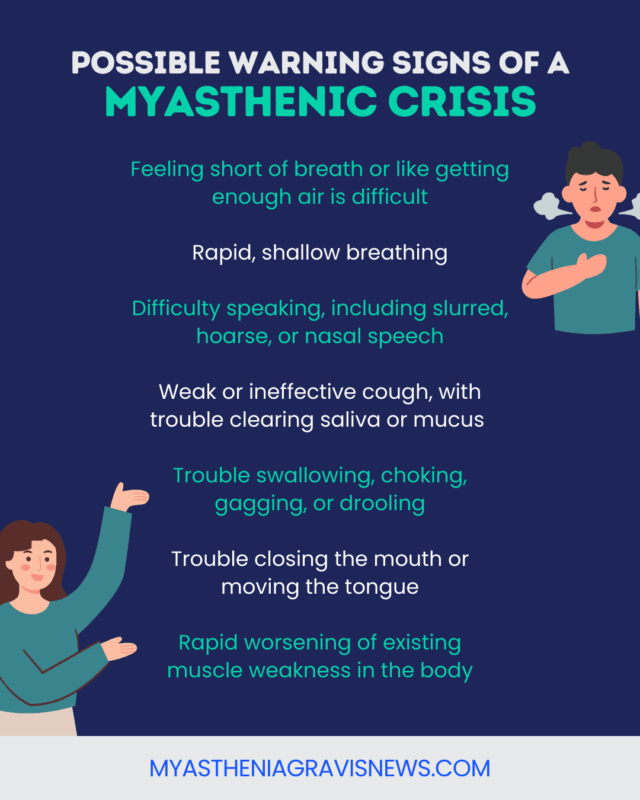
Historically, the myasthenic crisis mortality rate was around 50%-80%, but with improvements in emergency interventions for respiratory failure in MG, it’s now estimated that less than 10% of people who experience a myasthenic crisis die from it.
Respiratory infections, such as the flu or pneumonia, are the most common known triggers of myasthenic crises and are associated with an increased risk of death in MG.
Thymoma
Thymomas are tumors that develop in the thymus gland, a small organ in the chest that plays a key role in the immune system. These tumors are found in about 10%-15% of MG patients and are thought to contribute to the development of the disease.
Thymoma in MG has been associated with more severe disease and a higher risk of death.
Other factors
An older age at diagnosis is associated with a worse prognosis, with the MG survival rate generally being lower for people older than 50. The juvenile MG prognosis is generally better than that of adult-onset MG, typically with a normal life expectancy.
Some studies have also found that, even though MG is more prevalent in women, male patients may be at a slightly higher mortality risk than female patients.
Can treatment increase MG life expectancy?
While there is no cure for MG, several treatments are available that may help ease symptoms and improve quality of life. For some, MG can go into remission, in which patients have minimal or no symptoms temporarily or permanently.
Every patient responds to treatment differently, but it’s possible that appropriate treatment and monitoring can help to improve life expectancy for MG patients by:
- keeping symptoms under control and reducing the likelihood of life-threatening complications, such as myasthenic crisis
- slowing or delaying the progression of ocular MG to gMG
MG life expectancy with treatment is generally similar to the average seen in healthy people. Specific treatments associated with a positive impact on survival in MG patients include:
- thymectomy, or surgery to remove the thymus gland
- immunosuppressant medications
Some MG patients don’t respond well enough to treatment and have refractory disease. These patients may be at a higher risk of complications and death than those who do respond to treatment.
While MG treatments are key to preventing serious complications, most of them work by suppressing immune function, leaving patients at a higher risk of life-threatening infectious complications.
Ultimately, every patient is different, and treatment choices are influenced by many factors. There’s no guarantee that a treatment will extend a person’s life expectancy.
Future outlook and lifestyle changes
While many people live full and active lives with the neuromuscular disease, quality of life with MG can be substantially affected. Collaborating closely with a healthcare team to develop a personalized treatment plan can ensure that living with MG is as manageable as possible.
Certain lifestyle changes after an MG diagnosis may benefit a patient’s physical and mental health. This could include:
- eating a healthy diet
- drinking less alcohol and quitting smoking
- managing stress
- staying active and following an appropriate exercise regimen
These recommendations are similar to those advised for the general population. While lifestyle changes are not guaranteed to extend a person’s life, when combined with appropriate MG treatments, they can help patients live as healthily as possible.
Every patient’s needs are different. Individuals should always consult their doctor before making any lifestyle changes to ensure they are safe and suitable.
Myasthenia Gravis News is strictly a news and information website about the disease. It does not provide medical advice, diagnosis, or treatment. This content is not intended to be a substitute for professional medical advice, diagnosis, or treatment. Always seek the advice of your physician or other qualified health provider with any questions you may have regarding a medical condition. Never disregard professional medical advice or delay in seeking it because of something you have read on this website.