
 Discussion
Cladribine for myasthenia gravis
Last updated Sept. 13, 2024, by Lindsey Shapiro, PhD
 Fact-checked by Joana Carvalho, PhD
What is cladribine for myasthenia gravis?
Cladribine is a short-course oral therapy being developed by Merck Kgaa (EMD Serono in the U.S.) for generalized myasthenia gravis (gMG). It is designed to lower the levels of the immune cells that drive inflammatory attacks in gMG.
While still in Phase 3 testing for gMG, an oral tablet formulation of cladribine is already approved in the U.S. under the brand name Mavenclad for certain types of multiple sclerosis, an autoimmune disease that affects the nervous system. Injectable formulations of cladribine are also used to treat certain blood cancers.
Therapy snapshot
Scroll horizontally to view all columns -->
| Treatment name: | Cladribine |
| Administration: | Being tested in myasthenia gravis as oral capsules |
| Clinical testing: | In Phase 3 clinical testing |
How does cladribine work in myasthenia gravis?
Myasthenia gravis (MG) is caused by self-reactive antibodies that attack the sites of communication between nerve and muscle cells, the so-called neuromuscular junctions. This drives symptoms of muscle weakness and fatigue.
Cladribine is a molecule whose structure is similar to that of adenosine, a type of DNA building block known as a purine. When cladribine incorporates into the genetic material of lymphocytes, a type of white blood cell, it is transformed into a toxic form that significantly interferes with the DNA repair and replication mechanisms of cells, causing them to die off. In most cell types, cladribine is easily deactivated by certain enzymes, but that’s not the case with lymphocytes, which is why it selectively targets those cells.
Ultimately, this mechanism is expected to reduce the damaging immune activity that drives gMG, thereby easing disease severity.
How will cladribine be administered in myasthenia gravis?
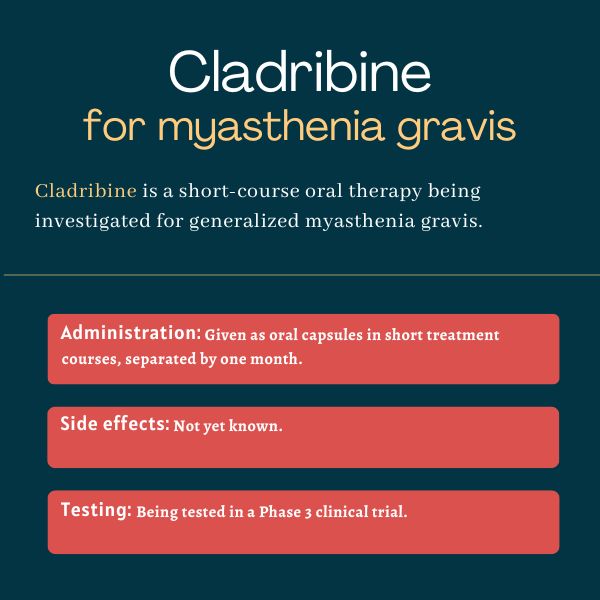
In a Phase 3 clinical trial involving gMG patients, cladribine is being given as oral capsules in two short courses, separated by a month, with additional courses being administered based on clinical need.
Cladribine in myasthenia gravis clinical trials
Researchers in Poland conducted a pilot study to evaluate the effects of injectable cladribine in 13 gMG patients who hadn’t responded to standard treatment. Patients received injections of cladribine over two consecutive days, which was repeated on a monthly basis if they failed to see clinical improvements.
Eleven patients exhibited significant clinical improvements, as assessed by the MG Composite (MGC) scale. The mean MGC score at study enrollment was 15.1, which significantly decreased (improved) to 6.3 points six months after the first dose. The treatment was generally well tolerated.
Ongoing trials
Merck Kgaa is sponsoring the Phase 3 MyClad trial (NCT06463587), which is evaluating the safety and efficacy of oral cladribine capsules in 240 adults with gMG.
In the first part of the study, participants will be randomly assigned to receive either a low or high dose of cladribine, or a placebo, given in two oral courses separated by a month. This will be followed by a blinded extension phase, in which participants initially randomized to the placebo will be assigned to receive either dose of cladribine and vice versa for another two courses. In the final retreatment period, all participants who require additional doses of cladribine will be retreated as clinically necessary.
The study’s main goal is to evaluate changes in disease severity after six months, as assessed by changes in the scores on the MG Activities of Daily Living scale. Safety, cladribine’s pharmacological properties, and other measures of disease severity will also be evaluated. The trial started dosing in August 2024 and is expected to finish in July 2030.
Common side effects of cladribine
Clinical testing of oral cladribine in people with gMG is still ongoing, so its side effect profile in this patient population is not known.
In people with multiple sclerosis, common side effects include headache, low levels of certain immune cells in the blood, and upper respiratory tract infections.
Myasthenia Gravis News is strictly a news and information website about the disease. It does not provide medical advice, diagnosis, or treatment. This content is not intended to be a substitute for professional medical advice, diagnosis, or treatment. Always seek the advice of your physician or other qualified health provider with any questions you may have regarding a medical condition. Never disregard professional medical advice or delay in seeking it because of something you have read on this website.
Related articles
-
Discussion
-
 Discussion
-
 Discussion
-
 Discussion
-
 Discussion
-
Discussion