
Q&A with MGFA exec reveals plans for new research in myasthenia gravis
Forums members get chance to ask real-time questions on work in MG
Written by |
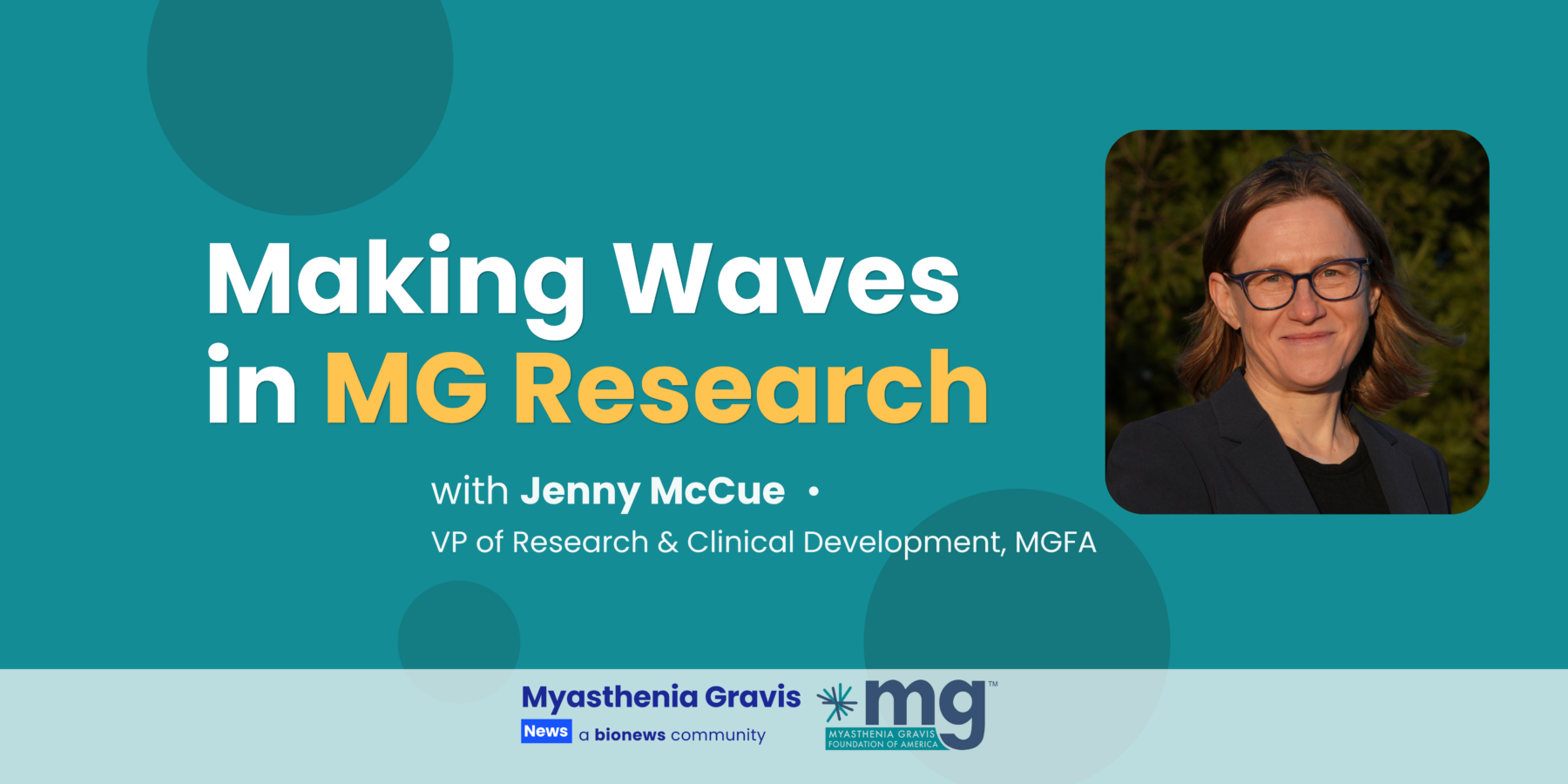
Jenny McCue serves as vice president of research and clinical development at the Myasthenia Gravis Foundation of America. (Photo courtesy of Jenny McCue; graphic by Jodi Enders)
- The Myasthenia Gravis Foundation of America funds research on the autoimmune neuromuscular disease and provides resources to the MG community.
- A foundation exec recently answered questions from members of the Myasthenia Gravis News forums on that work.
- Jenny McCue, the MGFA's vice president of research, said a key goal is bringing patient experiences into MG clinical trials.
The Myasthenia Gravis News forums welcomed Jenny McCue, vice president of research and clinical development at the Myasthenia Gravis Foundation of America (MGFA), for an hour-long Q&A earlier this month. Forum members had an opportunity to ask questions in real time about the latest in myasthenia gravis (MG) research.
McCue’s work at MGFA involves deciding which proposed studies are funded and prioritized — essential work in moving MG science forward and, she said, ensuring key research receives needed resources.
During the Q&A, McCue shared how MGFA is prioritizing funding, connecting with scientists, and elevating the patient population. The goal, according to McCue, is a world without MG.
The possibility of root cause treatment
McCue shared that research is looking promising, with new approaches that go beyond controlling symptoms and broad immune suppression.
Some treatments being developed could potentially target the root causes of MG, she noted, but McCue stressed that trial outcomes will bear the final word on what’s possible.
The MGFA directly funds some of that root-cause research through its grant program, an example of how the foundation is directly involved in shaping the science, according to McCue.
“There are some really exciting treatments coming online that could potentially be curative, but we have to wait and see,” McCue said. “We also know that MG is a very individual disease, which can mean that curative treatment needs to be the right fit for your MG. The trials are working on it. More and more advancements and learnings are happening.”

Where the research stands on seronegative MG
Many community members had the same question: What’s the latest on seronegative MG?
In this form of MG, standard antibody tests come back negative, and it’s an area where researchers still have many questions about causes, treatment, and appropriate testing.
McCue points out the cause still isn’t fully understood: Researchers suspect that some people may have an antibody not yet discovered, while others may have known MG antibodies at levels too low for standard tests to detect.
A more sensitive lab test, developed over the last decade or so, can detect those lower levels. However, it’s offered at only a handful of labs. McCue said the MGFA is advocating for wider access to more sensitive antibody testing, which could help some people receive a clearer diagnosis and potentially open additional treatment options for individuals diagnosed with this MG type.
She also pointed to recent case reports showing that some people diagnosed with seronegative MG have a different disease entirely.
“There have … been some case studies recently that found individuals diagnosed with seronegative MG did not have MG at all — some had CMS (congenital myasthenic syndromes), which is a genetic disease distinct from MG, or LEMS (Lambert-Eaton myasthenic syndrome),” McCue said. “Others had extremely rare metabolic or mitochondrial disorders — diseases so rare that [a] proper diagnosis was missed.”
When it comes to treatment, McCue noted the FDA’s recent expansion of the Vvygart and Vyvgart Hytrulo labels to cover all adult serotypes of generalized MG. This includes MuSK-positive, LRP4-positive, and triple-seronegative patients. This is the first approval in that drug class for people without any detectable antibody.
The MGFA expects more approvals to follow as other proven drug classes move through seronegative-specific trials, per McCue. The foundation maintains its dedicated seronegative resource center to keep patients up to date as research develops.
Picking and changing treatments
There are several drug classes now available for MG, including IVIG, FcRn blockers, and targeted B-cell therapies. However, McCue acknowledged there’s no established protocol — at least not yet, she says — for matching a patient to the right one before trial and error takes over. Developing that protocol is a high priority for the MGFA, she said.
When it comes to changing therapies, McCue pointed to the EPIC study, a head-to-head trial of two FcRn blockers with a built-in arm for patients who switch mid-trial. McCue said researchers are beginning to compare therapies more closely, and to study what happens when people switch from one treatment to another.
“There is work being done to develop new protocols to determine the right approach to trialing medications,” she said. “This is a priority for MGFA.”
In addition, the MGFA’s own patient registries are gathering real-world treatment-transition data and feeding it back into the field to ensure researchers have the information they need to establish medication protocols.

Reflecting real patient experiences in the research
The community and McCue agreed: Clinical trials should represent the full range of people who live with MG. This includes different antibody types, ages, disease severity, and lived experiences.
According to McCue, the MGFA’s role is that of a connector. The foundation gathers insights directly from people living with MG and matches these individuals to relevant trials. Then, the participants provide that invaluable lived-experience data to the clinicians and researchers who need it to design the next round of studies.
We need to ensure your lived experiences are a part of the conversation [in MG research].
“One of the things we are working on is to continue to gather insights from people living with MG and connect them to trials underway that may be relevant, and also share what we know about life with MG with clinicians and researchers so they can continue to include the MG community,” McCue said.
“We need to ensure your lived experiences are a part of the conversation,” McCue told the forum members.
She noted a specific trial now underway to address ocular MG, in which only the muscles that control the eyes and eyelids are affected. ADAPT oculus (NCT06558279) is a Phase 3 study of efgartigimod (marketed as Vygart Hytrulo), a therapy delivered weekly via a subcutaneous, or under-the-skin, injection for people with eye-droop symptoms.
When it comes to fatigue, things are trickier. Fatigue is one of the most common and difficult to treat MG symptoms because its causes are so varied, and McCue noted there’s no single drug to manage it. However, she flagged MGFA’s clinical trial database for patients to find fatigue studies and promised to share updates directly with the community as answers become available.
The next 3-5 years at MGFA
According to McCue, the MGFA prioritizes research that goes beyond just developing new medications.
When asked why so much MG research funding goes toward treatments rather than diagnostics or quality of life, McCue laid out MGFA’s grant priorities directly. These involve establishing biomarkers that can speed early diagnosis, predict clinical outcomes, and forecast who will respond to immunosuppressive therapy. The foundation also has a dedicated research track on patient outcomes.
McCue said MGFA’s grant program is focusing on several areas:
- finding biological clues that could help diagnose MG earlier
- understanding why the immune system starts attacking the body
- developing treatments that act more precisely
- studying how MG affects everyday life and improving care for children with MG
“We serve as the connector of researchers so they can further their own education and make connections that can drive investigations forward, faster,” McCue said.
Beyond grantmaking, MGFA coordinates gatherings that bring researchers and patients together to share ideas, learn from each other, and build new collaborations, she noted.
The MGFA Scientific Session at the AANEM Annual Meeting provides neurologists and other physicians an informal opportunity to discuss their basic or clinical research work related to the neuromuscular junction. The MGFA International Conference is an opportunity for neuromuscular researchers and medical professionals to share their work with peers around the world.
Finally, the National Patient Conference is one of the largest gatherings of the MG community in the world.

MGFA’s contributions to the community
During McCue’s time in the forum, she offered actionable insights for people living with MG and a window into how the MGFA is moving things forward. There were several key takeaways:
- Involvement in funding science: The MGFA funds and prioritizes research through its grant programs, giving precedence to biomarker and root-cause discovery, targeted therapies, improved patient outcomes, and trial-diversity efforts.
- Concrete testing and trial information: From sensitive testing options for seronegative MG to a Phase 3 trial for ocular symptoms, McCue provided information and opportunities for the MG community to share with their healthcare teams.
- Prioritizing patients: The MGFA’s patient registries, resource centers, and annual events keep patients top of mind and part of the conversations driving research forward.
Each of those efforts is part of MGFA’s larger vision of a world without MG, according to McCue.
While many questions still lack answers, McCue emphasized the importance of elevating the experiences of those living with MG as research advances.



Leave a comment
Fill in the required fields to post. Your email address will not be published.