
MDA Engage: CAR T-cell therapy offers new hope for MG care
Specialist highlights advancing treatments and daily energy planning
Written by |
- Myasthenia gravis is a chronic autoimmune condition with symptoms that include drooping eyelids, double vision, and difficulty speaking, swallowing, or breathing.
- At a recent MDA Engage event, a neurologist highlighted emerging treatments like CAR T-cell therapy while urging myasthenia gravis patients to take charge of their own care and daily energy management.
- The future of myasthenia gravis care relies on personalized treatment plans guided by the patient.
People living with myasthenia gravis (MG) have more treatment options today than ever before, and emerging approaches like CAR T-cell therapy could soon add another powerful tool, a neurologist told patients and caregivers at a recent educational event.
Even with a growing list of therapies, effective care still starts with patients taking charge of their own health goals.
“You should be the leader of this team,” said Carlos Lara, MD, a board-certified neurologist and assistant professor of neurology at UChicago Medicine who specializes in MG and other neuromuscular disorders. “You are not just a patient. You are the center of this team.”
Lara spoke during a session titled “Myasthenia Gravis” at the MDA Engage: Chicago event held Sept. 26. The symposium brought together patients, family caregivers, doctors, and patient advocates to discuss recent medical progress and community support.

Understanding a complex condition
MG is a chronic autoimmune disease in which the body’s immune system mistakenly attacks its own tissues. In MG, self-reactive antibodies disrupt the communication between nerves and muscle cells, leading to muscle weakness and fatigue. Common symptoms include drooping eyelids, double vision, and difficulty speaking or swallowing. While shortness of breath is less common early on in MG, Lara urged patients to act quickly and advocate for themselves.
About 85% of people with MG test positive for these disease-causing antibodies. However, a negative antibody test does not rule out the condition. “It means that we don’t know,” Lara explained. In those cases, antibodies may exist at levels too low for standard lab tests to detect, or they may involve unidentified antibody types. Because of these variations, “there is no myasthenia patient alike,” he said.
Recent years have brought new, targeted medications. The treatment landscape shifted rapidly following the U.S. Food and Drug Administration’s approvals of Soliris (eculizumab) for MG in 2017 and Vyvgart (efgartigimod alfa-fcab) in 2021.
CAR T-cell therapy on the horizon
Newer treatments work in different ways. Some, such as Uplizna (inebilizumab-cdon), reduce the number of immune cells that produce the harmful antibodies that drive MG. FcRn blockers, such as Imaavy (nipocalimab-aahu), help the body clear those antibodies faster. Complement inhibitors like Zilbrysq (zilucoplan) target another part of the immune system that’s believed to contribute to the damaging immune response seen in MG.
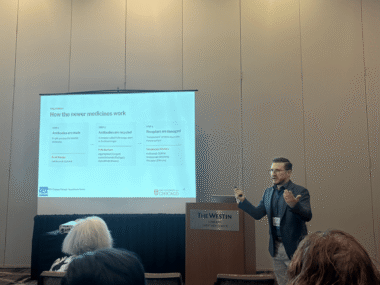
Carlos Lara, MD, a board-certified neurologist and assistant professor of neurology at UChicago Medicine, speaks at MDA Engage. (Photo by Douglas Backstrom)
Among upcoming treatments, Lara expressed the most enthusiasm for CAR T-cell therapy. In this procedure, doctors harvest a patient’s own white blood cells, genetically reprogram them in a laboratory to target and attack antibody-producing cells, and reinfuse them back into the patient. Several experimental CAR T-cell therapies are under development for MG, but Descartes-08 is among those in more advanced stages, with a Phase 3 clinical trial currently underway.
“CAR T-cell therapy is the forefront, I think,” Lara said. “We’re just very, very excited to see those trials coming up.”
The approach has shown strong results in lupus, another autoimmune disease. “So we will see what happens with our myasthenia situation,” Lara said.
Despite these advances, older treatments remain essential tools. These include therapies that improve signal transmission between nerves and muscles, oral immunosuppressants, and fast-acting emergency treatments like intravenous immunoglobulin and plasma exchange.
CAR T-cell therapy is the forefront, I think. We’re just very, very excited to see those trials coming up.
Managing steroid risks and daily energy
Steroids remain a tricky part of care. They are medications “we all rely on, we all fear at the same time,” Lara said. While powerful at curbing inflammation and easing symptoms, long-term steroid use carries significant health risks.
When an audience member asked about stopping steroids after suffering bone fractures, Lara explained that reducing steroid reliance is a primary goal of newer treatments. However, he acknowledged candidly that many patients cannot eliminate them entirely.
“Yes, the goal is to get to zero, but sometimes patients, most of the patients, cannot get to it,” he said.
Stopping steroids suddenly can also be dangerous. After years on steroids, the body may stop producing enough of its own natural steroid hormones, a condition called adrenal insufficiency. As a result, dose changes must be managed slowly under strict medical supervision, sometimes in combination with other immunosuppressive therapies like rituximab.
Managing daily life with MG also requires smart energy budgeting. Lara compared living with MG to managing a smartphone battery that drains faster than normal.
To preserve strength, he recommended simple daily adjustments, such as using a shower chair, switching to an electric toothbrush, and scheduling physical activity for times of the day when energy levels are highest. Emotional stress can also act as a major trigger for symptom flare-ups, so pacing daily tasks is essential.
Finally, Lara emphasized safety precautions. Certain common prescription drugs, including specific antibiotics, can worsen muscle weakness. He advised patients to carry a medical alert card listing their MG diagnosis and contraindicated medications. Because immunosuppressive therapies can reduce vaccine effectiveness, patients should also consult their doctor about the optimal timing of vaccinations before starting a new medication.
Neck weakness, shortness of breath, and swallowing problems are all potential emergencies. “If you feel something’s wrong, just ask for help,” Lara said.
His primary advice to caregivers was to listen. Some days, a person with MG needs a little push, and some days they need rest, he said. Like a phone, they need time to recharge.
He encouraged patients and families to learn about the disease and to take questions to their doctors. “You’re entitled to your own information,” he said.
Lara also pointed to resources from the Myasthenia Gravis Foundation of America and to clinical trials that may be available near patients’ homes.
Note: The Myasthenia Gravis News team is providing coverage of the MDA Engage Symposium. Go here to see the latest stories from the conference.



Leave a comment
Fill in the required fields to post. Your email address will not be published.