
Skip to content
  • For Healthcare Professionals
Myasthenia Gravis News logo
Newsletter
  • For Healthcare Professionals
  • About MG
    Myasthenia gravis overview
    • Causes
    • Symptoms
    • Diagnosis
    • Prognosis
    • Prevalence
    Treatment options for MG
    • Approved treatments
    • Experimental treatments
    Types of MG
    • Ocular myasthenia gravis
    • Generalized myasthenia gravis
    • Transient neonatal myasthenia gravis
    • Juvenile myasthenia gravis
  • Living with
    Living with myasthenia gravis
    Mental health
    Remission
    Diet
    Exercise and physiotherapy
    Managing swallowing
    Heat sensitivity
    Vitamin D
    Support groups and resources
  • Community
    Community Videos
    Perspectives
    • My Bitter & Best Friend: MG — Sarah Bendiff
    • Together — Mark Harrington
    • The Whispered Roar — Shawna Barnes
    More Perspectives
    • Me, My Brother, and MG — Allen Francis
    • A Good Life with Bad Muscles — Retha De Wet
    • Never Give Up — Bob Kuppler
    • Obstacles Can Excite Creativity — Jodi Enders
    • Positively MG — Megan Hunter
    • Strength in Weakness — Michelle Gonzaba
    Guest Voices
    Myasthenia Gravis Awareness Month
  • News
  • Forums
  • Resources
    Video and webinar
    • Breakthrough
    • Lean in
    • Fine’s not enough
    • Reality of Rare
    • MG won’t wait
    • Finding balance
    • Coping with change
    • Pushing back at MG webinar
    • Rarely speaking webinar
    Featured topics
    • Strong, realistic, safe
    • Navigating MG
    • MGLife360
    • Set the pace hub
    • Big MG questions, clear answers
    Advocacy partners
    Provider finder
    MDA Engage Symposium
    MGFA Scientific Session

Myasthenia gravis guide to clinical trials

Last updated Aug. 6, 2025, by Agata Boxe
✅ Fact-checked by Patrícia Silva, PhD

What is a clinical trial?
Benefits and risks
Types of MG clinical trials
Where to find
Questions to ask
Additional information


Although researchers have made progress with therapies for myasthenia gravis (MG), further work is needed to help manage fatigue, and to improve strength, mobility, and quality of life in people with the autoimmune-related disease.

Scientists continue to explore new treatments through clinical trials, which test whether therapies are safe and effective before they are approved by the U.S. Food and Drug Administration (FDA) or other regulatory agencies

Enrolling in an MG clinical trial can give you access to experimental therapies while helping to advance scientific understanding and treatment options. However, it is key to consult your doctor before deciding whether participation is right for you.

What is an MG clinical trial?

A clinical trial is a carefully designed research study that assesses new ways to treat, manage, or monitor diseases such as MG. It is usually done after lab and animal testing.

MG clinical trials may focus on:

  • reducing fatigue and improving muscle weakness through medication
  • investigating treatments that may reduce autoantibody production
  • studying new therapy delivery methods, such as infusion versus oral
  • assessing tools to better track MG symptom changes and responses to treatment.

Clinical trials for MG typically follow four phases:

  • Phase 1 trials usually test safety and dosage in a small group of participants.
  • Phase 2 trials usually evaluate the effectiveness of treatment while continuing to monitor safety.
  • Phase 3 trials generally compare the new therapy to a placebo or existing standard treatment in a larger group.
  • Phase 4 trials are done after FDA approval to study long-term safety and effectiveness in a real-world setting.

The benefits and risks of MG trials

The severity of your MG symptoms, such as fatigue, muscle weakness, and droopy eyelids, can influence whether you choose to join a clinical trial. However, it is still important to consider both its benefits and risks.

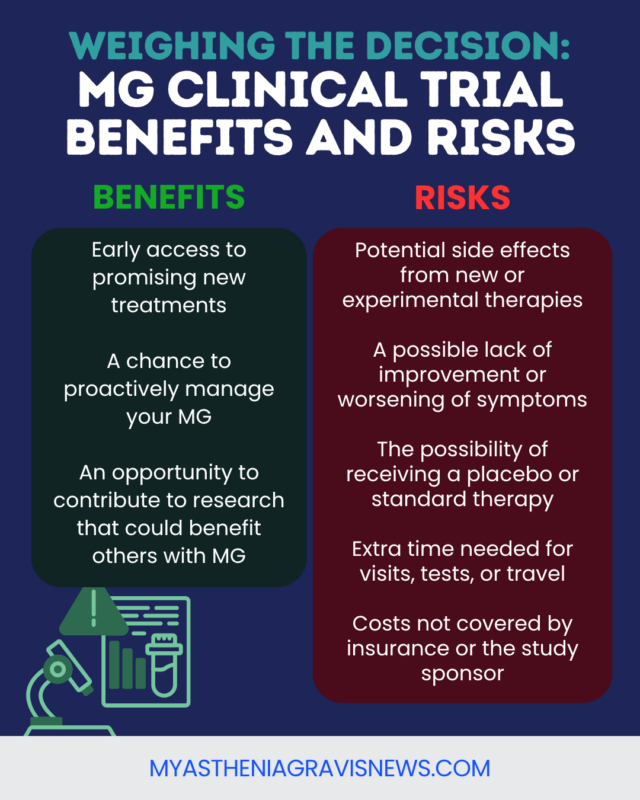
The benefits of MG clinical trials include:

  • early access to promising new treatments
  • a chance to proactively manage your MG
  • an opportunity to contribute to research that could benefit others with MG.

The risks of clinical trials include:

  • potential side effects from new or experimental therapies
  • a possible lack of improvement or worsening of symptoms
  • the possibility of receiving a placebo or standard therapy
  • extra time needed for visits, tests, or travel
  • costs not covered by insurance or the study sponsor.

Types of MG clinical trials

Clinical trials for MG can explore various treatments, including:

  • immunomodulating therapies
  • monoclonal antibody-based treatments for MG
  • medications designed to improve nerve-muscle communication.

Some trials will address refractory, or hard-to-treat, MG, and involve people who do not respond to approved treatments. Other studies will test the use of imaging, digital tools, or biomarkers to better track disease activity.

Many MG trials enroll people with generalized MG, where the disease causes muscle weakness in varying parts of the body. Others may target other MG types, such as ocular MG, which mostly affects the muscles responsible for controlling eye and eyelid movements.

Where to find MG clinical trials

To learn about MG clinical trials, start by talking to your neurologist. As a specialist, your neurologist may be aware of trials at academic centers, hospitals, or research networks, and can inform you whether you’re eligible.

You can find additional information through online resources.

For information about clinical trials in the United States, you can try these websites:

  • ClinicalTrials.gov
  • CenterWatch
  • Myasthenia Gravis Foundation of America
  • National Institutes of Health
  • Research Match.

For trials outside the U.S., these websites may be helpful:

  • EU Clinical Trials Register
  • ISRCTN Registry (UK)
  • World Health Organization
  • Australian New Zealand Clinical Trials Registry.

What to ask before joining an MG clinical trial

If you’re considering participating in an MG clinical trial, asking questions can help you make an informed decision. Consider compiling a list of questions for your MG doctor, the research team, and even yourself as you learn more about the trial process.

There are certain questions you might ask your MG doctor:

  • Am I a good candidate for an MG clinical trial?
  • Are you aware of any current clinical trials for MG that would be suitable for my disease type and symptoms?
  • Would participating in a trial affect my current treatment plan?
  • What are the potential risks and benefits of the trial you may be recommending?
  • What would the trial require in terms of treatment, travel, and time commitment?

Other questions can be asked of the research team:

  • What kind of treatment will the trial be testing, and why do you think it will work?
  • Are there any known side effects, and if so, how can they be managed?
  • Does this study involve a placebo or another MG treatment that is already on the market?
  • What are the odds of receiving a placebo or another MG therapy versus the new treatment?
  • Who will cover the costs of my participation in the trial, and do I need insurance?

Inquiring about costs is especially important. While many trials cover the cost of experimental treatments and related care, some may not. If you’re insured, you can contact your provider to see if the company can cover participation-related expenses.

Finally, consider this list of questions to ask yourself:

  • What do I hope to gain from this trial? Are my expectations realistic?
  • Am I prepared for potential side effects or the possibility of receiving a placebo?
  • Can I manage the time and travel requirements?
  • How may participation affect my daily life and mental health?
  • Am I prepared to handle the emotional impact if the treatment doesn’t work for me?

Additional information about MG clinical trials

Clinical trials for MG can offer access to new treatments, as well as a way to perhaps more actively engage in your own care. However, trial participation may not be suitable for everyone, so carefully considering the potential benefits and risks is crucial.

Consult your doctor before enrolling, and don’t hesitate to ask questions — your voice and initiative matter for managing MG symptoms and planning your future.


Myasthenia Gravis News is strictly a news and information website about the disease. It does not provide medical advice, diagnosis, or treatment. This content is not intended to be a substitute for professional medical advice, diagnosis, or treatment. Always seek the advice of your physician or other qualified health provider with any questions you may have regarding a medical condition. Never disregard professional medical advice or delay in seeking it because of something you have read on this website.

Clinical trial news

A magnifying glass hovers over a single checked box on a survey sheet featuring checked and unchecked boxes. Discussion
News

New patient registry aims to collect real world evidence on MG in US

Aiming to address a persistent gap in myasthenia gravis (MG) research, Vitaccess is teaming up with the Myasthenia Gravis Foundation of America (MGFA) to expand real-world data collection in MG. As part of the new exclusive agreement, MGFA will become the official collaborator for the Vitaccess Real MG…
A patient seated on an examination table takes some oral medication as a doctor offers her a cup of water. Discussion
News

Arthritis drug tofacitinib may be effective for hard-to-treat MG: Study

Tofacitinib, an approved medication for some types of inflammatory arthritis and inflammatory bowel disease, improves muscle strength, daily functioning, and quality of life in people with hard-to-treat myasthenia gravis (MG), according to a small pilot clinical trial. Slightly more than half of the participants experienced few or no symptoms…

Two hands, a stethoscope, and a handful of oral medications frame a graph marked Clinical Trial that shows positively trending results. Discussion
News

CAR T-cell therapy offers year-long relief for gMG patients in trial

A single course of six once-weekly infusions of Descartes-08, an investigational CAR T-cell therapy, was well tolerated and resulted in sustained clinically meaningful responses in people with generalized myasthenia gravis (gMG). That’s according to final data from the Phase 2b MG-001 clinical trial (NCT04146051), which also showed…

Discussion
News

Top 10 MG news stories of 2025

In 2025, Myasthenia Gravis News delivered readers timely reporting on research, treatments, and clinical trials for myasthenia gravis (MG). We have compiled the 10 most-read stories for a recap of the year, each accompanied by a brief summary. As we enter 2026, we look forward to continuing our…

The words Discussion
News

FDA puts experimental gMG therapy cladribine on fast track

Note: This story was updated Nov. 26, 2025, to correct that the cladribine formulation being tested as a potential gMG treatment differs from the one used in Mavenclad, an approved therapy for multiple sclerosis. The U.S. Food and Drug Administration (FDA) has granted fast track designation to cladribine, an…

  • Prev
  • 1
  • 2
  • 3
  • 4
  • 5
  • 6
  • 7
  • 8
  • …
  • 42
  • Next
  • Prev
  • Next

Recent Posts

  • Reclaiming His Voice: A Pastor’s gMG Story
  • Understanding myasthenia gravis blood tests
  • 10 things I wish I knew after my diagnosis of myasthenia gravis
  • Study comparing key gMG treatment options finds similar efficacy
  • New Zilbrysq delivery option OK’d by FDA for adults with myasthenia gravis


  Subscribe to our newsletter

Get regular updates to your inbox.

This field is for validation purposes and should be left unchanged.

Bionews Logo Bionews, Inc.

3 W Garden St
Suite 700
Pensacola, FL 32502
Website: bionews.com
Email: [email protected]
Phone: 1-800-936-1363

  • Myasthenia Gravis News on Facebook
  • Myasthenia Gravis News on X
  • Myasthenia Gravis News on Instagram
  • Myasthenia Gravis News on Threads
  • Myasthenia Gravis News on Bluesky
  • About Us
    • Our Culture
    • Our Communities
    • Leadership
    • Careers
    • Contact Us
  • Explore More
    • Advertising Policy
    • Corrections Policy
    • Editorial Policy
    • Privacy Policy
    • Terms of Service
    • Cookie Settings
Disclaimer

This site is strictly a news and information website about the disease. It does not provide medical advice, diagnosis or treatment. This content is not intended to be a substitute for professional medical advice, diagnosis, or treatment. Always seek the advice of your physician or other qualified health provider with any questions you may have regarding a medical condition. Never disregard professional medical advice or delay in seeking it because of something you have read on this website.

Copyright © 2013-2026 All rights reserved.

Log in

Don't have an account?

Log in

[wppb-login register_url="/register" lostpassword_url="/recover-password" ajax=true]

|

Register

Already have an account?

Register

Create your account by filling in the information below:

[wppb-register redirect_url="/" ajax=true]

By creating an account, you are agreeing to the Privacy Policy and Terms of Service.

Reset Password

[wppb-recover-password ajax=true]