














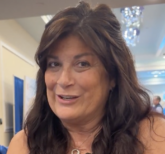
Artist and muralist Sophie Groenstein shares how living with MG reshaped her relationship with art, movement, self-expression, and personal identity.
Transcript
Hi, my name is Sophie Groenstein, and I’m a Connecticut muralist and illustrator.
2022 is when I graduated, and I just fell in love with public art and honoring community through a larger scale. And when I was painting murals, I just was starting to realize that things weren’t going easy for me physically. And I had a feeling that something was wrong.
I couldn’t use my extremities the right way, such as my arms when I was painting really high up, or even just simply standing for long periods of time, or what I thought were considered long periods of time. It was definitely myasthenia gravis, and I had no idea. And so through that, it was just years of going undiagnosed, not knowing what was going on.
So I became almost like a hermit and kind of just stuck to my own and stuck to being at home. And through that, I started to lose myself in a way. And being an artist, it’s so important to know who you are.
And I always like to feature individuality and personalities through my artwork, so I just had a hard time creating pieces about individuality and portraiture without knowing who I was truly and knowing my identity.
I was diagnosed last year in April. In the hospital, I received some treatment and, you know, through that, I started to feel better and I started to finally feel like myself again — finally knowing that I had an answer and I can go back and live my life even better than what I was doing before.
And I told myself that “If I could create murals and if I could create these large-scale works for communities, then I can do it even on medicine.” So it just truly inspired me to become my best self ever through this diagnosis. I was inspired to just push myself creatively.
Right now, in my body of work, I’m focusing on femininity and also body movement, and I’m sure a lot of people who are diagnosed and also have very similar symptoms of like generalized myasthenia gravis, they can also experience the effects of physical endurance and physical exhaustion.
So I thought it was honestly very, like, therapeutic form of art for me and for me to be celebrating movement of the body and appreciating these weird, almost like contorted poses, but yet very like calming poses as well. And you might be able to see like two of them right behind me as well.
So they’re about relaxation and self-care and knowing when to rest. And also these pieces represent growth and transformation. I truly feel like my work as an artist has inspired me to find myself as well, and also to continue to know my limits that I have of symptoms for myasthenia gravis, and to be my best self as an artist and a person.
Myasthenia gravis is a part of my story — but it has not taken away my ability to smile, to connect with others, and to enjoy life at its fullest.
And I think what I would recommend and what I would say to other artists who do have myasthenia gravis, is to find yourself in your pieces and really accept this diagnosis and condition for what it is, and you don’t have to make it your full center of focus, but use it honestly as an inspiration for your work.
Because as an artist, you are creating work through your personality and through your lens. So your personal experiences and your story, and especially story with myasthenia gravis, is all affected in what you create.